







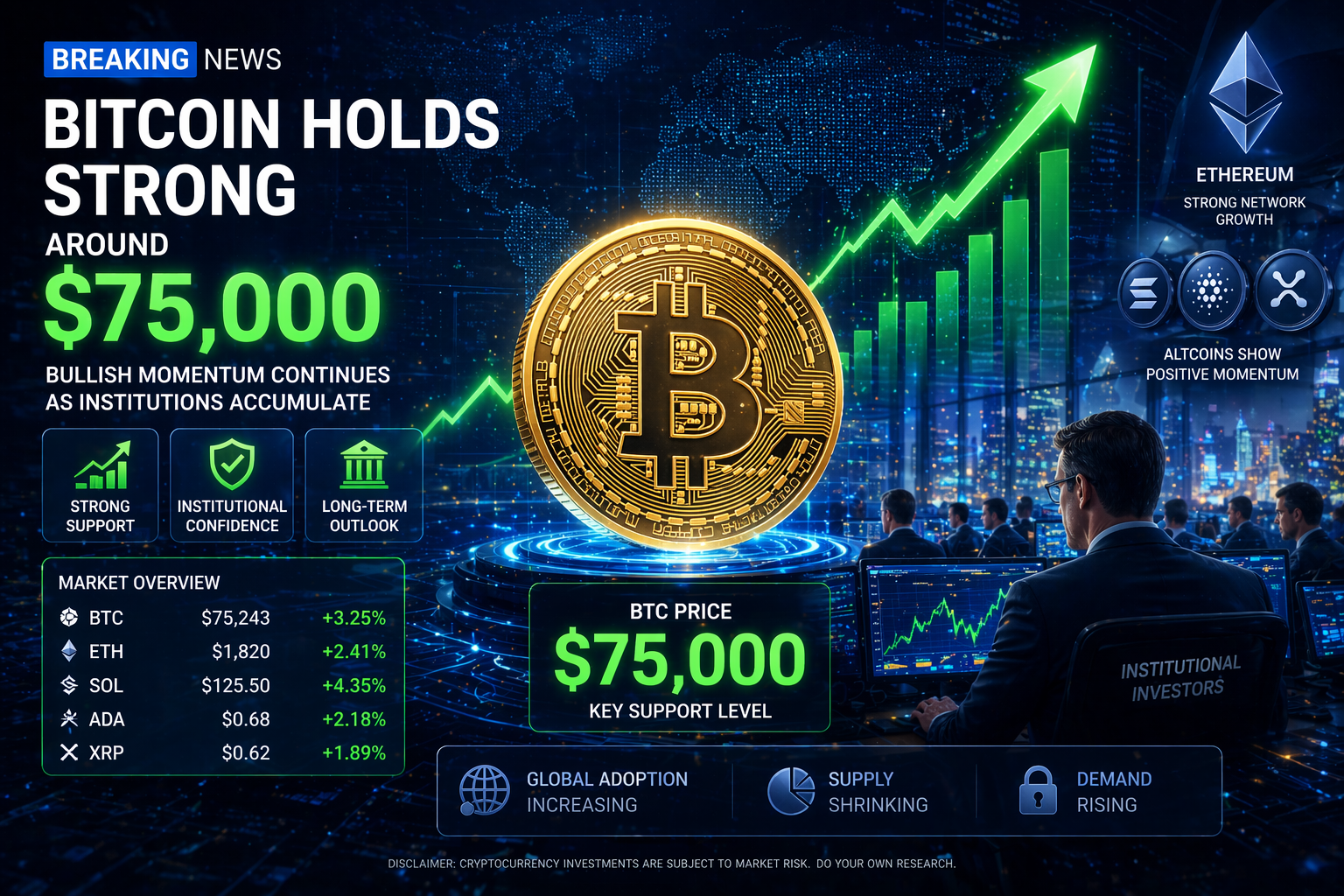
Bitcoin is showing early signs of stabilization after recent volatility, trading around the $75,800 level as renewed institutional demand provides support at lower price ranges. The recovery comes after Bitcoin briefly tested support near $73,800, where buyers stepped in aggressively, signaling that large players continue to accumulate during dips. While price action remains relatively stable for now, the broader market is still navigating a mix of macroeconomic uncertainty and geopolitical risks, which could influence the next directional move.
Alongside Bitcoin, Ethereum is holding steady near the $2,300 mark, indicating that the broader crypto market is entering a consolidation phase rather than experiencing a sharp reversal. This stability across major assets suggests that while short-term momentum may be limited, underlying demand remains intact. Market participants are closely watching whether this consolidation will lead to a continuation of the uptrend or a period of sideways movement before the next breakout.
Institutional Demand Drives Recovery Momentum
A key factor behind Bitcoin’s recent rebound has been strong institutional buying activity, which continues to act as a stabilizing force in the market. Large-scale purchases by institutional entities have reinforced confidence among investors, particularly after a period of heightened volatility driven by macroeconomic concerns. One notable development includes a significant Bitcoin acquisition by a major corporate entity, highlighting that long-term players are still actively building positions despite short-term price fluctuations.
This pattern reflects a broader trend in the crypto market, where institutional participation is increasingly shaping price movements. Unlike retail-driven rallies, institutional inflows tend to provide more sustained support, as these participants often operate with longer investment horizons. As a result, dips in Bitcoin’s price are increasingly viewed as accumulation opportunities rather than signals of a broader downturn.
Resistance Levels Cap Immediate Upside
Despite the recovery, Bitcoin’s upside remains limited in the near term, with strong resistance forming around the $78,000 level. Analysts suggest that this price range has become a critical barrier, preventing further upward movement and keeping the market within a defined trading range. The current structure indicates consolidation, where buyers and sellers are in relative balance, and neither side has established clear dominance.
This range-bound behavior is typical during transitional phases in the market, where momentum from previous rallies begins to slow, and traders wait for new catalysts. Breaking above the $78,000 level would likely require a significant increase in buying pressure, potentially driven by favorable macroeconomic data or continued institutional inflows. Until then, the market is expected to remain cautious, with price movements largely confined within established support and resistance levels.
Macro Factors and Federal Reserve Outlook in Focus
Beyond technical levels, macroeconomic conditions continue to play a crucial role in shaping the crypto market. Investors are closely monitoring upcoming economic data, including employment figures and purchasing managers’ index (PMI) reports, which could influence expectations around monetary policy. The stance of the Federal Reserve remains particularly important, as interest rate decisions and liquidity conditions have a direct impact on risk assets like cryptocurrencies.
At the same time, geopolitical tensions in the Middle East are adding another layer of uncertainty. Rising oil prices and potential disruptions in global supply chains could contribute to inflationary pressures, which in turn may affect central bank policy decisions. These factors create a complex environment where both macroeconomic stability and geopolitical developments must be considered when assessing market direction.
Altcoin Market Shows Selective Strength
While Bitcoin and Ethereum remain the primary focus, the altcoin market is also showing signs of selective participation. BNB, Solana, XRP, and Dogecoin have maintained relatively stable price levels, reflecting a cautious but steady approach among investors. This indicates that while risk appetite has not fully returned, there is still underlying interest in alternative assets within the crypto ecosystem.
The current market behavior suggests that investors are being more selective, focusing on assets with strong fundamentals or institutional backing rather than chasing speculative opportunities. This shift could lead to a more mature market structure over time, where capital flows are driven by long-term value rather than short-term hype.
Market Structure Points to Consolidation Phase
From a broader perspective, the crypto market appears to be entering a consolidation phase following recent volatility. This phase is characterized by stable price ranges, reduced volatility, and a gradual buildup of positions by both institutional and retail participants. Such periods are often necessary for the market to establish a strong foundation before the next major move.
Analysts suggest that this consolidation should not be viewed negatively, as it allows the market to absorb recent gains and adjust to new levels of demand. However, traders are advised to remain cautious, particularly when approaching resistance levels, as aggressive positioning in uncertain conditions can lead to increased risk.
Outlook: Stability With Potential for Breakout
Looking ahead, Bitcoin’s ability to maintain support above key levels will be critical in determining whether the current recovery can continue. If institutional demand remains strong and macro conditions stabilize, the market could see a gradual move toward higher resistance levels. On the other hand, any negative developments—whether economic or geopolitical—could reintroduce volatility and test lower support zones.
For now, the market appears balanced between optimism driven by institutional activity and caution stemming from external uncertainties. This dynamic is likely to define price action in the near term, with traders closely watching for signals that could indicate the next major trend.