







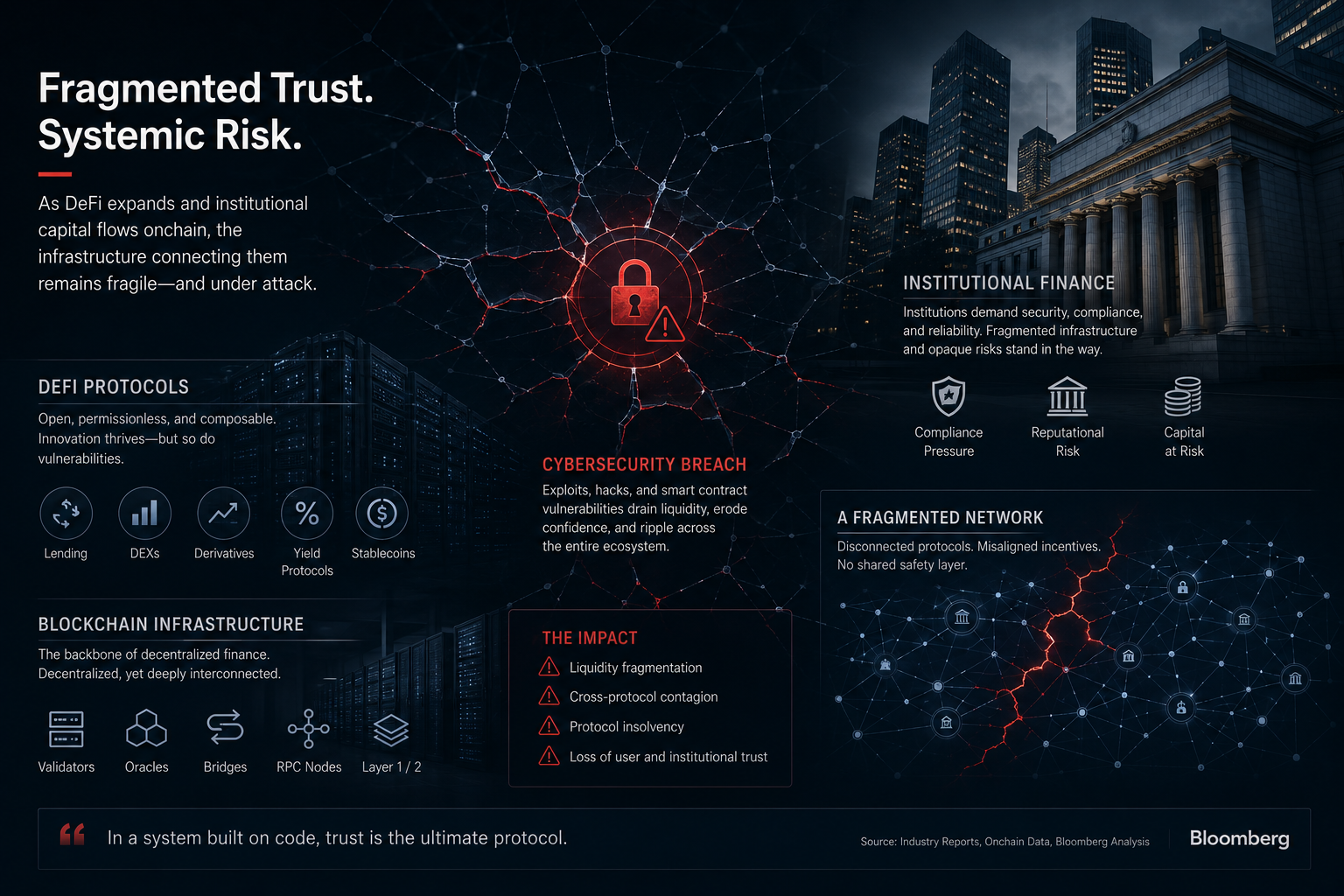
Decentralized finance was originally designed to create an open financial system where users could transact, borrow, lend, and manage assets without relying on centralized intermediaries.
- Why DeFi’s “Trustless” Narrative Is Being Challenged
- Why Smart Contract Vulnerabilities Remain a Massive Problem
- Why DeFi Security Risks Are Slowing Institutional Adoption
- Cross-Chain Infrastructure Is Increasing Systemic Risk
- DeFi vs Traditional Finance: The Security Gap
- Why Governance Is Becoming a Critical Weakness
- Why Real-World Asset Tokenization Raises the Stakes
- The Industry May Be Moving Toward Hybrid Financial Systems
- Can DeFi Recover User Trust?
- Final Thoughts
- FAQ
Over the past several years, DeFi has grown into a multi-billion-dollar ecosystem powering:
- decentralized exchanges
- lending protocols
- derivatives platforms
- stablecoin systems
- yield strategies
- cross-chain infrastructure
However, repeated protocol exploits, bridge hacks, governance attacks, and smart contract vulnerabilities are creating a growing crisis of confidence across the industry.
As losses from security failures continue increasing, many analysts are beginning to question whether DeFi can realistically scale into mainstream financial infrastructure without major improvements in:
- security
- governance
- operational resilience
- institutional safeguards
The future of decentralized finance may ultimately depend less on innovation — and more on trust.
Why DeFi’s “Trustless” Narrative Is Being Challenged
One of DeFi’s core promises has always been the concept of “trustless finance.”
Instead of relying on banks or centralized institutions, blockchain protocols use smart contracts to automate transactions and financial services.
In theory:
- code replaces intermediaries
- transactions become transparent
- systems operate autonomously
- users maintain direct control over assets
However, repeated exploits are increasingly exposing weaknesses in this model.
When protocols lose millions of dollars through:
- smart contract vulnerabilities
- governance failures
- bridge exploits
- oracle manipulation
- liquidity attacks
users are forced to rely on trust once again:
- trust in developers
- trust in protocol governance
- trust in auditors
- trust in security infrastructure
This creates a major contradiction within the DeFi ecosystem.
The technology may be decentralized, but user confidence still depends heavily on whether systems can reliably protect assets.
Why Smart Contract Vulnerabilities Remain a Massive Problem
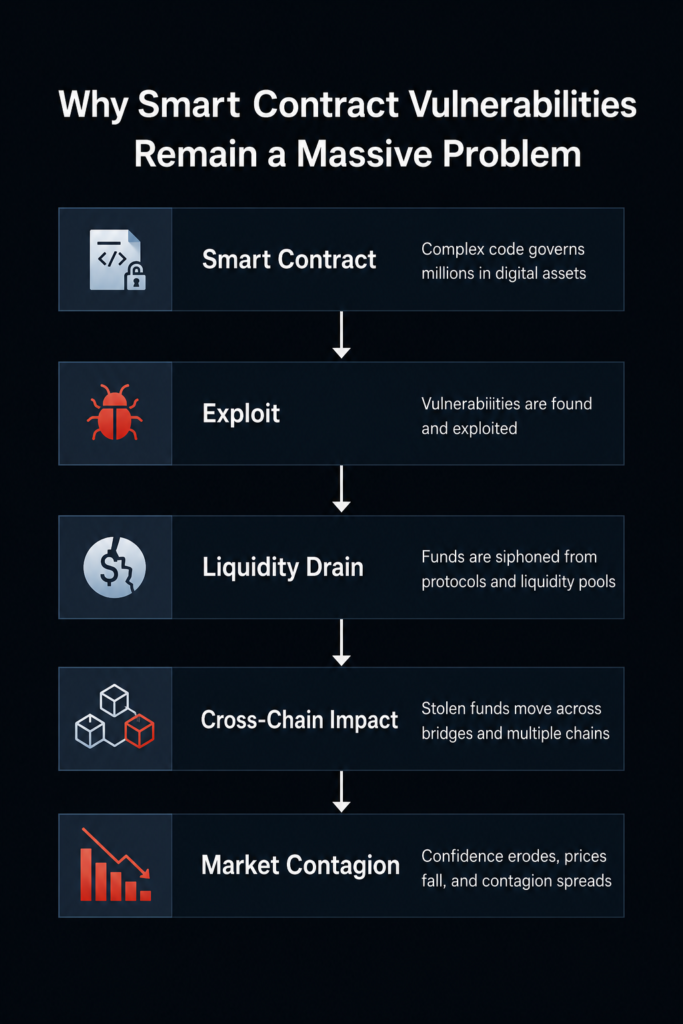
Many DeFi protocols operate using highly complex smart contract architectures.
These systems often manage:
- billions in liquidity
- leveraged positions
- automated liquidations
- collateral management
- cross-chain messaging
Even small coding errors can create catastrophic financial consequences.
Several major incidents over recent years have demonstrated how vulnerable DeFi infrastructure can become under stress.
Cross-chain systems and interoperability layers have proven especially risky because they increase technical complexity and expand potential attack surfaces.
As blockchain ecosystems become more interconnected, vulnerabilities in one protocol can rapidly spread across multiple platforms.
Modern smart contract security systems are increasingly integrating AI-assisted auditing tools and automated vulnerability detection to reduce these risks:
However, even advanced auditing systems cannot fully eliminate the risks associated with rapidly evolving DeFi architectures.
Why DeFi Security Risks Are Slowing Institutional Adoption
Institutional capital has shown increasing interest in blockchain technology and tokenized financial systems.
However, many institutions remain cautious about DeFi participation due to:
- protocol exploits
- governance instability
- unclear regulations
- liquidity risks
- operational uncertainty
Traditional financial systems operate with:
- insurance mechanisms
- incident response frameworks
- regulatory oversight
- centralized recovery systems
DeFi ecosystems often lack many of these protections.
This gap creates significant concerns for institutional participants managing large-scale capital.
Growing discussions around institutional blockchain adoption show that traditional finance is increasingly exploring blockchain infrastructure — but primarily within regulated and security-focused environments:
If DeFi cannot improve security standards substantially, institutional adoption may continue shifting toward permissioned or centralized blockchain systems instead of fully decentralized ecosystems.
Cross-Chain Infrastructure Is Increasing Systemic Risk
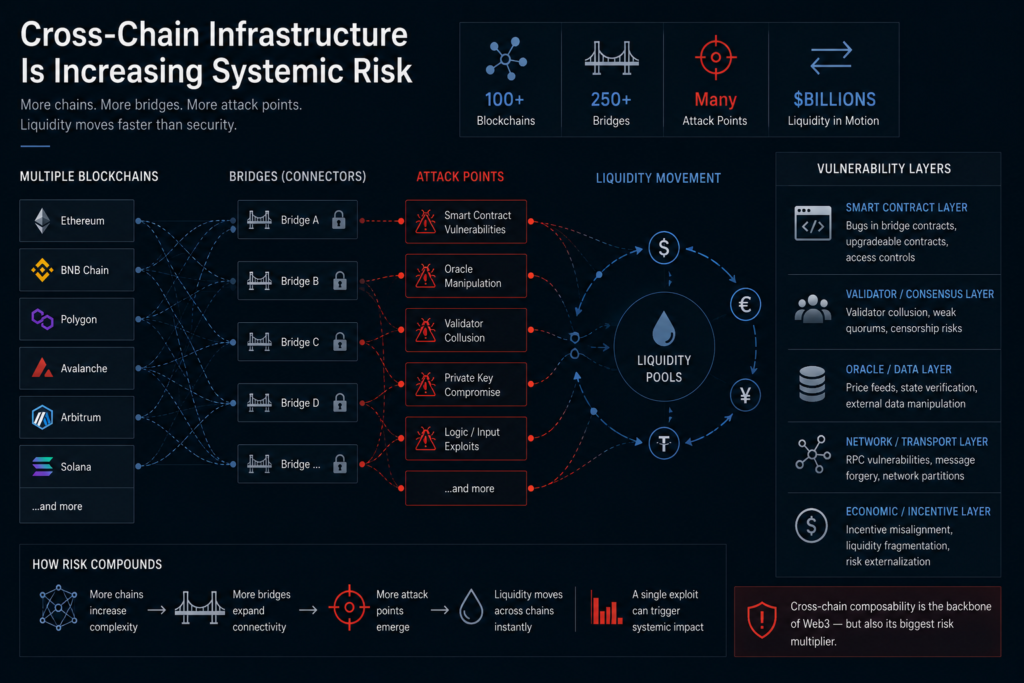
One of the fastest-growing sectors in Web3 involves interoperability infrastructure connecting multiple blockchain ecosystems together.
Cross-chain systems help enable:
- asset transfers
- liquidity movement
- messaging protocols
- multi-chain applications
However, bridges and interoperability layers have also become some of the most heavily targeted areas in the blockchain industry.
Bridge exploits have resulted in billions of dollars in losses across the crypto ecosystem.
The reason is simple:
cross-chain systems introduce additional layers of complexity and dependency.
A vulnerability in one component can create cascading failures across:
- multiple blockchains
- liquidity pools
- lending protocols
- token ecosystems
As tokenized financial infrastructure expands, these interconnected risks may become even more dangerous.
Growing concerns around tokenized financial infrastructure are already influencing how regulators and institutions evaluate blockchain-based markets:
DeFi vs Traditional Finance: The Security Gap
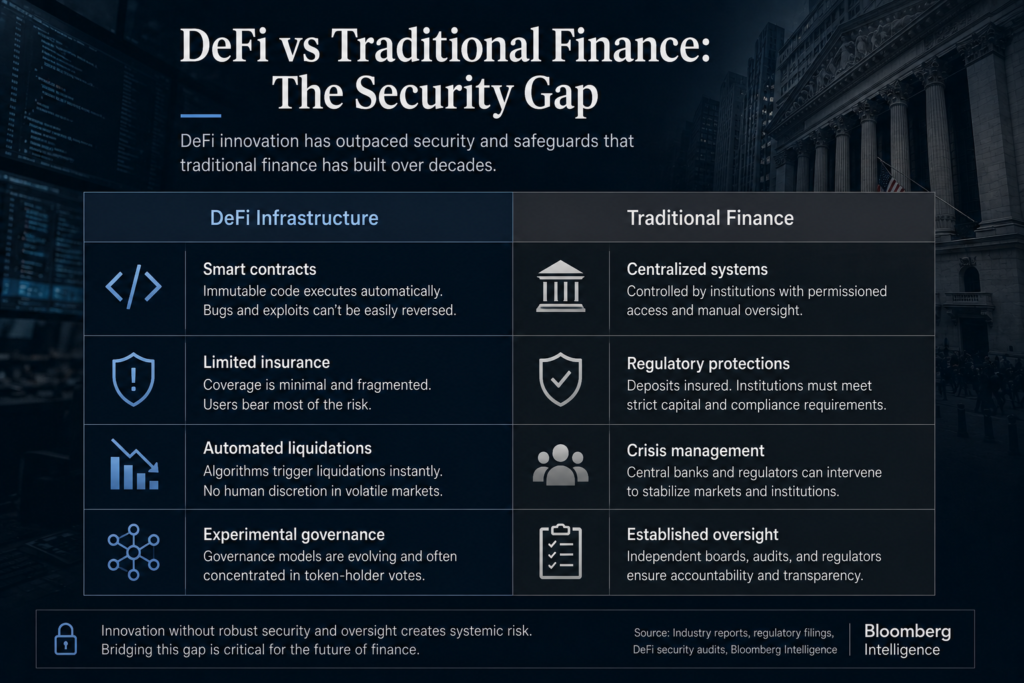
The security gap between decentralized finance and traditional financial systems remains substantial.
Traditional finance benefits from decades of:
- regulatory development
- cybersecurity investment
- institutional risk management
- legal frameworks
- operational controls
Banks and financial institutions typically maintain:
- dedicated security teams
- incident response systems
- fraud monitoring
- insurance protections
- compliance infrastructure
Many DeFi protocols, by comparison, still operate with:
- smaller development teams
- limited audits
- experimental governance structures
- rapidly deployed codebases
This does not necessarily mean traditional finance is immune to failures.
However, institutional systems generally include mechanisms for:
- crisis management
- regulatory intervention
- customer recovery
- liquidity stabilization
These safeguards are still underdeveloped across much of DeFi.
Why Governance Is Becoming a Critical Weakness
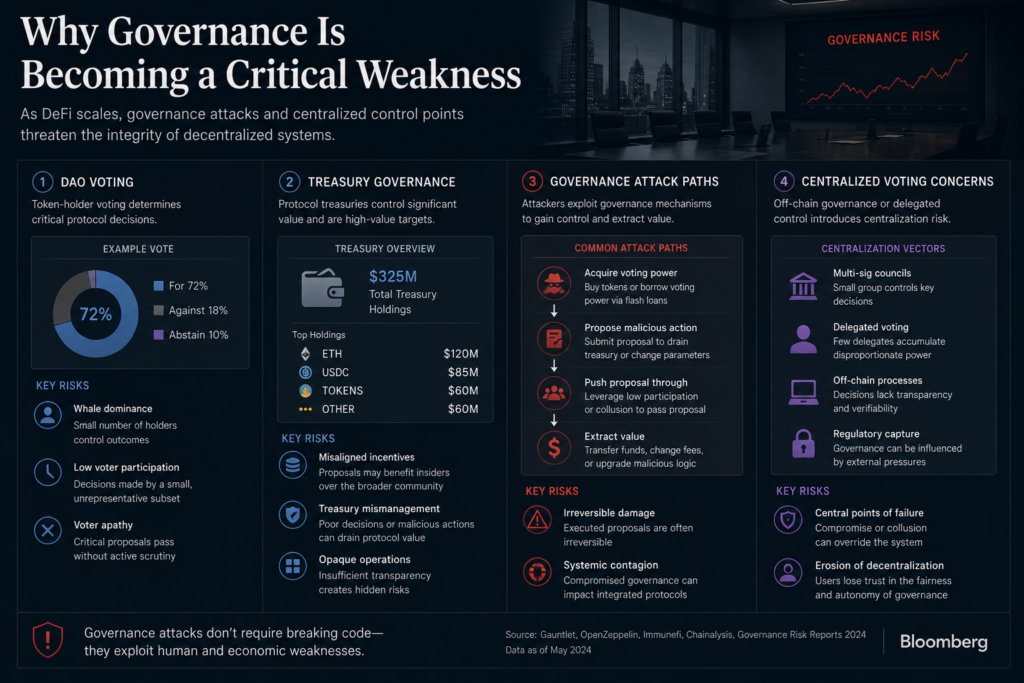
Security issues in DeFi are not limited to code vulnerabilities alone.
Governance structures themselves are increasingly becoming attack vectors.
Many decentralized protocols rely on:
- token voting systems
- treasury governance
- multisig controls
- DAO proposals
Poor governance participation or centralized voting concentration can create vulnerabilities that undermine decentralization itself.
Governance failures may lead to:
- malicious proposals
- treasury exploitation
- protocol manipulation
- delayed incident response
As protocols scale, governance resilience may become just as important as smart contract security.
Why Real-World Asset Tokenization Raises the Stakes

One of the largest opportunities for DeFi involves tokenized real-world assets (RWAs).
The ability to tokenize:
- bonds
- real estate
- commodities
- treasury products
- credit markets
could significantly expand blockchain-based financial systems.
However, bringing institutional capital into DeFi also dramatically increases expectations around:
- security
- compliance
- reliability
- operational stability
If DeFi infrastructure continues suffering repeated exploits, institutions may avoid open decentralized systems entirely.
Instead, they may favor:
- private blockchain networks
- regulated tokenization systems
- centralized custody models
- permissioned infrastructure
This could fundamentally reshape the future direction of blockchain finance.
The Industry May Be Moving Toward Hybrid Financial Systems
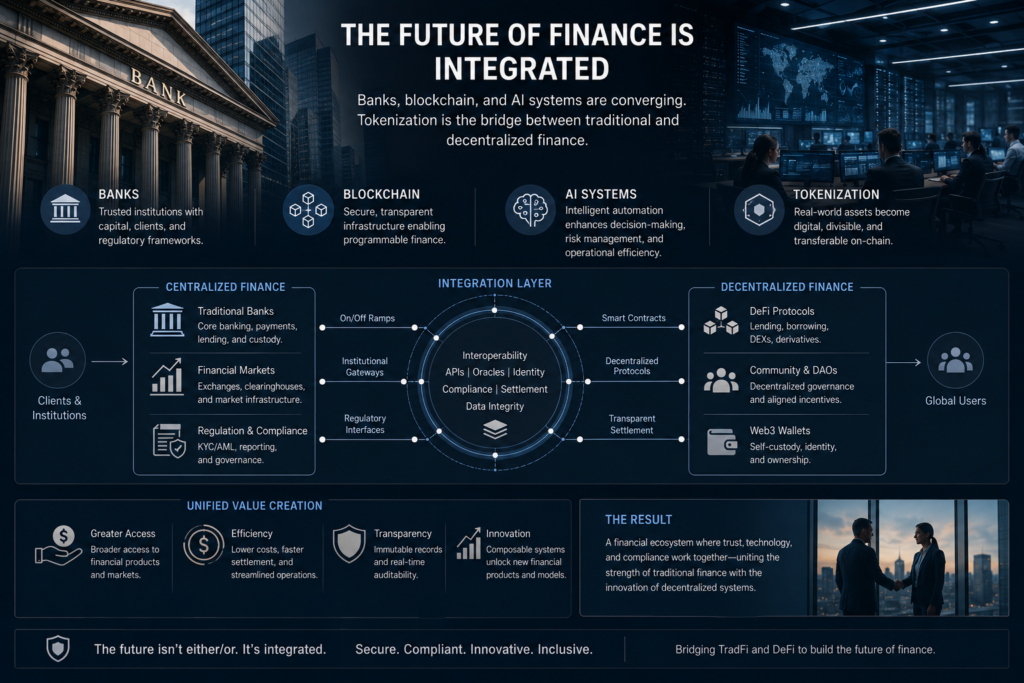
Rather than fully replacing traditional finance, DeFi may ultimately evolve into hybrid infrastructure combining:
- decentralized automation
- institutional safeguards
- regulatory oversight
- blockchain settlement systems
This convergence is already becoming visible across:
- stablecoin markets
- tokenization projects
- crypto custody
- institutional blockchain infrastructure
Even discussions surrounding Bitcoin’s role in cybersecurity infrastructure demonstrate how decentralized systems are increasingly intersecting with broader institutional and strategic frameworks:
The long-term success of DeFi may depend on whether the industry can balance:
- decentralization
- scalability
- security
- institutional trust
Can DeFi Recover User Trust?
Despite ongoing challenges, DeFi still offers significant advantages compared to traditional financial systems.
These include:
- global accessibility
- programmable finance
- reduced intermediaries
- open participation
- financial transparency
However, rebuilding trust will likely require major improvements in:
- auditing standards
- protocol governance
- insurance systems
- incident response
- security infrastructure
Without these safeguards, the industry risks remaining an experimental ecosystem rather than becoming mainstream financial infrastructure.
The next phase of DeFi adoption may be determined less by technological innovation — and more by whether users and institutions believe decentralized systems are safe enough to trust.
Final Thoughts
DeFi remains one of the most innovative sectors within the blockchain industry, but its long-term future now depends heavily on security and trust.
Repeated exploits, governance failures, and interoperability vulnerabilities are exposing the limitations of rapidly evolving decentralized systems.
As institutional adoption accelerates and tokenized financial infrastructure expands, expectations around reliability and operational resilience will continue increasing.
The future of decentralized finance may ultimately depend on whether the industry can successfully transition from:
- experimental infrastructure
to:
- secure financial infrastructure.
Without stronger safeguards, DeFi risks losing the very trust required for mainstream adoption.
FAQ
Why is DeFi considered risky?
DeFi protocols can contain smart contract vulnerabilities, governance weaknesses, and interoperability risks that may result in financial losses.
What are the biggest security risks in DeFi?
Major risks include smart contract exploits, bridge attacks, governance manipulation, oracle failures, and liquidity vulnerabilities.
Why are institutions cautious about DeFi?
Institutions often require stronger security, regulatory clarity, insurance protections, and operational safeguards before allocating capital.
What are cross-chain bridge risks?
Cross-chain bridges connect blockchain ecosystems but can introduce additional attack surfaces and systemic vulnerabilities.
Can DeFi become mainstream financial infrastructure?
DeFi has strong long-term potential, but widespread adoption will likely require major improvements in security, governance, and institutional trust.