







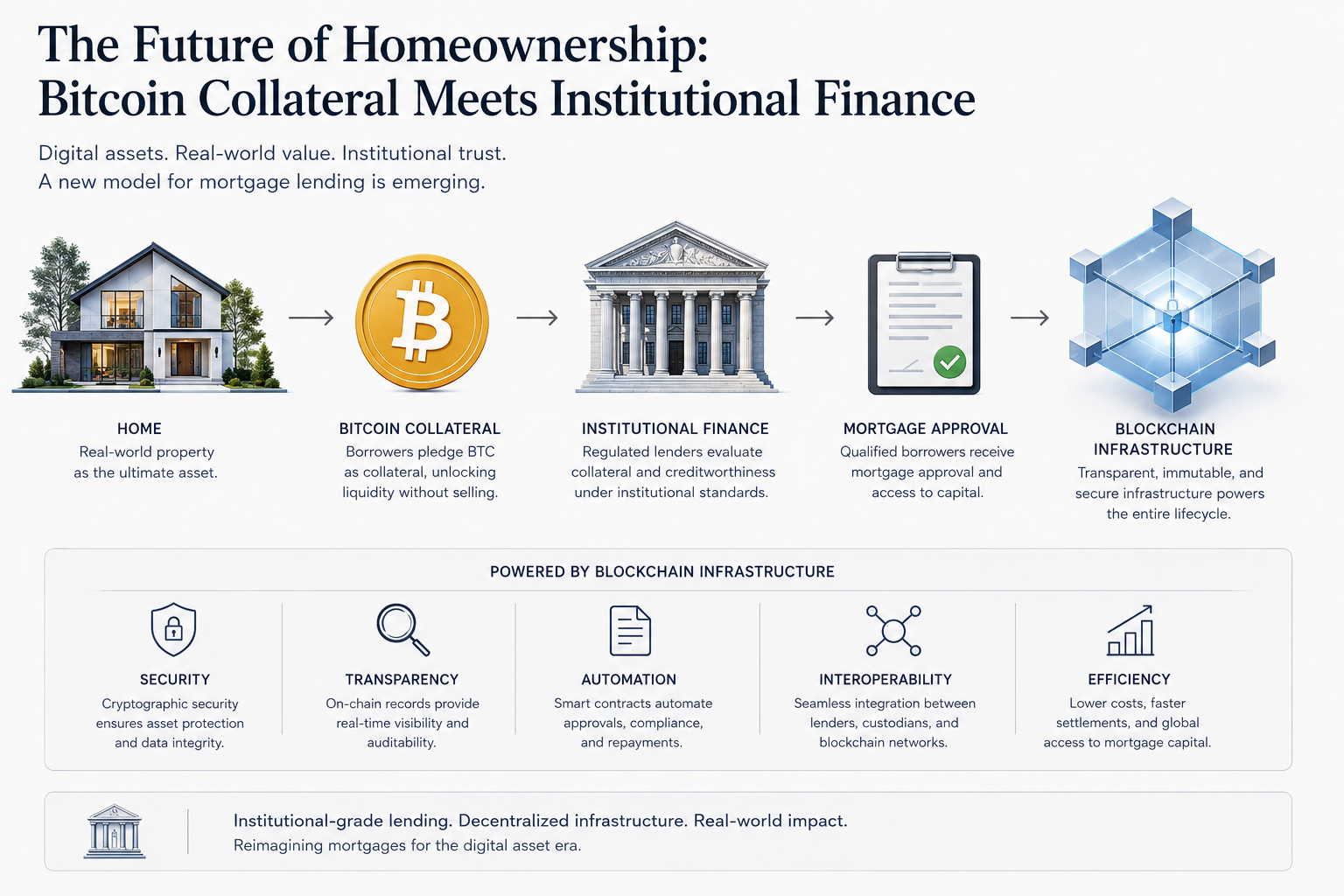
The relationship between cryptocurrency and traditional finance is evolving rapidly. What began as an alternative financial movement centered around decentralized assets is now increasingly merging with institutional banking, lending, and financial infrastructure.
- Why Bitcoin Is Increasingly Being Treated as Financial Infrastructure
- How Bitcoin-Backed Mortgages Work
- Why Avoiding Forced Bitcoin Sales Matters
- The Difference Between DeFi Lending and Mortgage Infrastructure
- Why Institutions Are Moving Toward Crypto-Backed Finance
- Why This Could Matter for the Housing Market
- Risks and Challenges Still Exist
- What Could Happen Next?
- Final Thoughts
- FAQ
One of the clearest signs of this transformation is the emergence of Bitcoin-backed mortgage products that allow borrowers to access home financing without selling their crypto holdings.
A new lending model introduced through collaboration between Coinbase and Better Mortgage is bringing this concept closer to mainstream adoption. The structure allows users to pledge Bitcoin as collateral while securing fiat-based mortgage financing through a regulated framework tied to traditional mortgage systems.
This development reflects a broader shift in how digital assets are being integrated into real-world financial infrastructure.
Why Bitcoin Is Increasingly Being Treated as Financial Infrastructure
For years, Bitcoin was primarily viewed as:
- a speculative investment
- a volatile trading asset
- an alternative monetary system
However, institutional adoption has significantly changed that narrative.
Bitcoin is now increasingly being discussed within the context of:
- collateralized lending
- treasury management
- financial infrastructure
- institutional reserves
- decentralized settlement systems
Growing discussions around Bitcoin’s role in cybersecurity infrastructure are also reshaping how governments and institutions evaluate decentralized networks.
This broader institutional recognition is helping transform Bitcoin from a speculative asset into a more functional component of modern finance.
How Bitcoin-Backed Mortgages Work
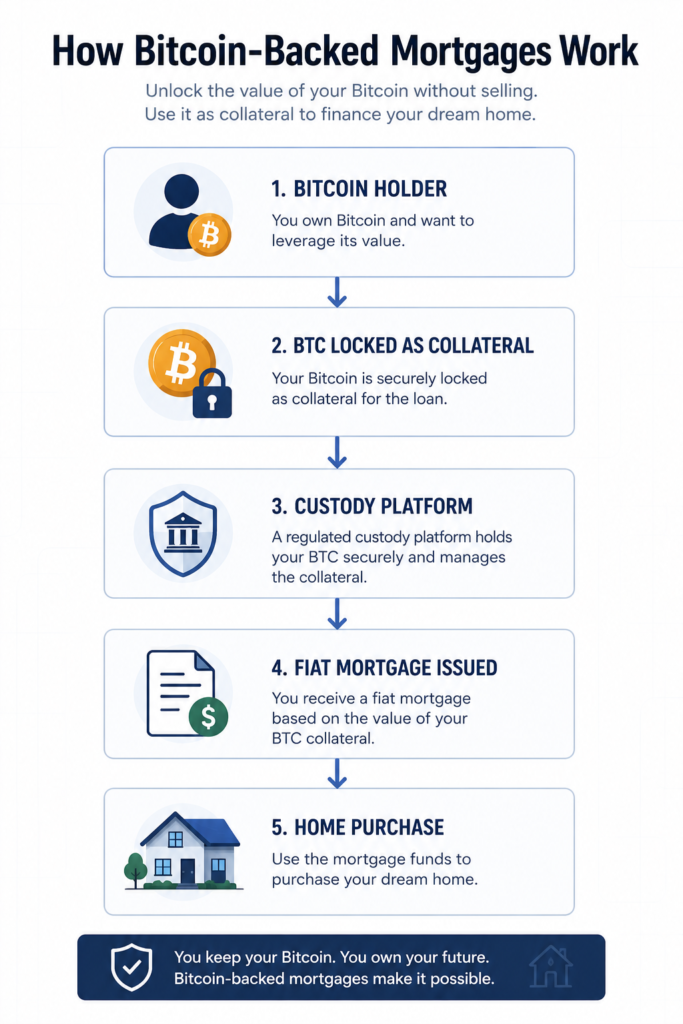
The new mortgage structure allows borrowers to use Bitcoin as collateral while receiving a traditional fiat mortgage loan.
Instead of liquidating their holdings to fund a property purchase, borrowers can:
- lock BTC in custody
- maintain market exposure
- secure home financing
- access liquidity without triggering a sale
This creates a major difference compared to traditional crypto liquidation models.
The structure also reportedly aligns with frameworks connected to Fannie Mae, allowing these loans to integrate into broader mortgage infrastructure systems.
This is important because it moves crypto-backed lending closer to regulated financial markets rather than isolated DeFi environments.
Why Avoiding Forced Bitcoin Sales Matters
One of the biggest long-term concerns for crypto holders has been the need to sell assets to access liquidity.
Selling Bitcoin often creates:
- taxable events
- reduced long-term exposure
- missed upside potential
- portfolio disruption
Bitcoin-backed mortgages attempt to solve this problem by allowing holders to retain ownership exposure while using their assets as collateral.
For long-term investors, this model may provide:
- capital efficiency
- tax flexibility
- liquidity access
- portfolio continuity
As digital assets become more integrated into financial systems, collateral-based crypto lending models may become increasingly common.
The Difference Between DeFi Lending and Mortgage Infrastructure
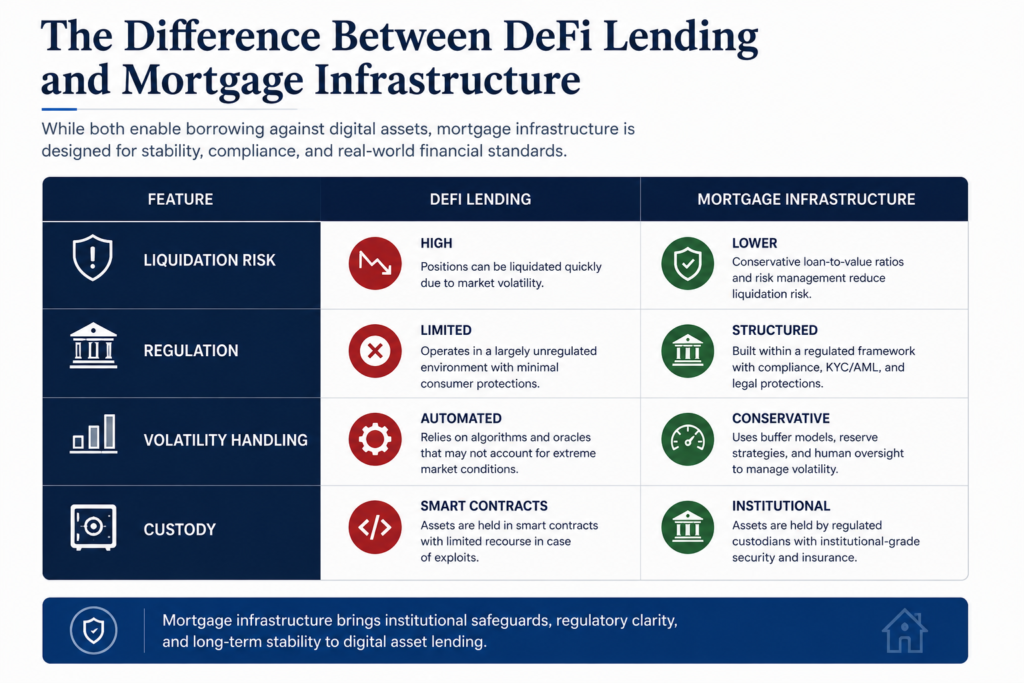
Traditional DeFi lending platforms often operate using automated liquidation systems.
If collateral values fall below required thresholds:
- assets can be liquidated automatically
- borrowers may lose positions quickly
- volatility can trigger cascading sell-offs
This has historically been one of the biggest risks associated with crypto-backed borrowing.
The newer mortgage-based model appears designed differently.
Rather than functioning purely through automated DeFi mechanics, the structure introduces:
- conservative lending ratios
- institutional oversight
- regulated custody systems
- traditional mortgage risk frameworks
This could reduce some of the volatility risks commonly associated with decentralized crypto lending.
However, risk still remains.
The broader blockchain industry continues facing major digital asset infrastructure risks tied to volatility, regulation, and financial stability:
Why Institutions Are Moving Toward Crypto-Backed Finance
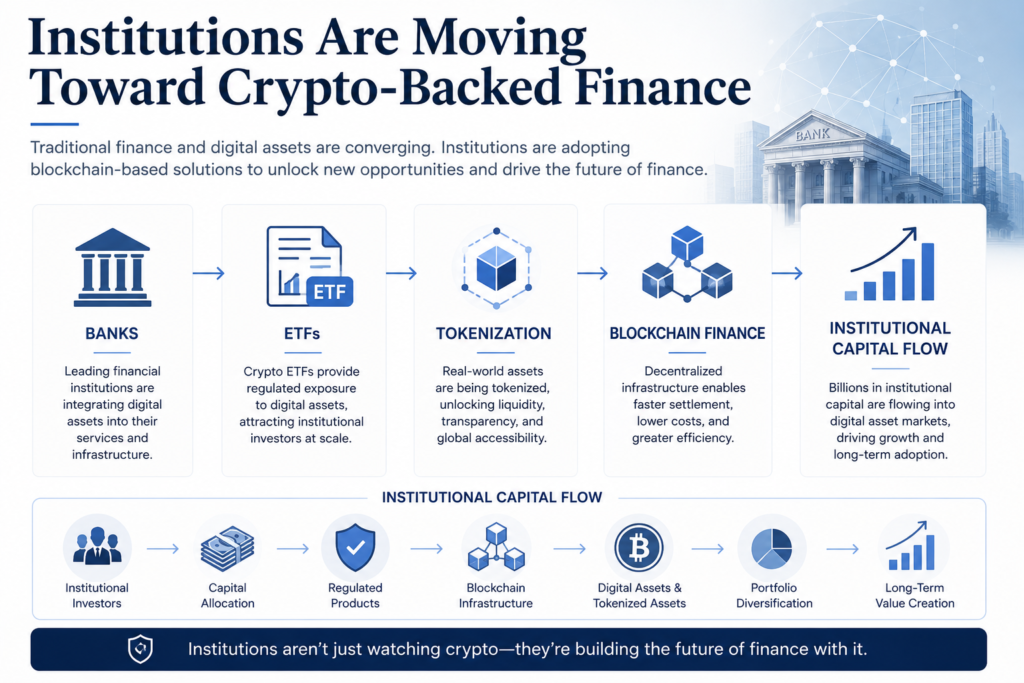
Institutional interest in blockchain infrastructure has expanded significantly over recent years.
Major financial firms are increasingly exploring:
- tokenized assets
- blockchain settlements
- crypto custody
- stablecoin systems
- decentralized infrastructure
- collateralized lending
This broader movement toward institutional blockchain adoption is changing how traditional finance interacts with digital assets:
Bitcoin-backed mortgages are part of this larger trend where crypto is transitioning from speculative trading into integrated financial infrastructure.
As institutional participation grows, more regulated crypto-finance products may emerge across:
- lending
- insurance
- settlements
- real estate
- payments
- treasury systems
Why This Could Matter for the Housing Market
Although still early, crypto-backed mortgage models could eventually influence how property financing operates globally.
Potential long-term impacts include:
- increased financial flexibility for crypto holders
- alternative collateral structures
- greater digital asset legitimacy
- integration of blockchain wealth into traditional banking
For younger investors who accumulated wealth through digital assets, these products may create pathways into real estate ownership without requiring full liquidation of crypto portfolios.
This is particularly relevant as more individuals hold significant portions of wealth in digital assets rather than traditional investment vehicles.
Risks and Challenges Still Exist
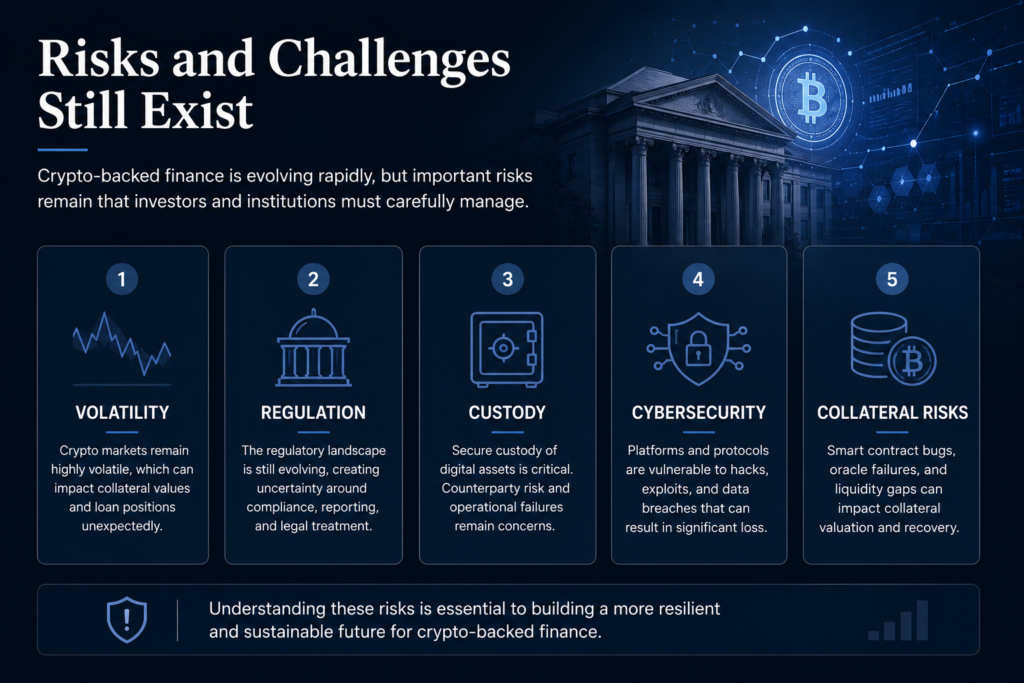
Despite the innovation, Bitcoin-backed mortgages also introduce several important risks.
Volatility Risk
Bitcoin remains highly volatile compared to traditional collateral assets.
Large market swings could still create:
- collateral pressure
- lending instability
- risk management challenges
Regulatory Uncertainty
Governments worldwide are still developing frameworks surrounding:
- crypto lending
- custody rules
- digital asset taxation
- mortgage regulation
- financial compliance
Future policy changes may significantly impact adoption.
Custody and Security Risks
Crypto-backed financial systems depend heavily on secure custody infrastructure.
The broader Web3 ecosystem continues facing serious DeFi security risks and cybersecurity challenges:
As institutional crypto lending expands, cybersecurity standards will likely become even more important.
The Bigger Shift: Crypto Is Becoming Financial Infrastructure
The most important takeaway may not be the mortgage product itself.
Instead, it is what the product represents.
Bitcoin is gradually evolving from:
- speculative digital asset
into:
- financial collateral
- infrastructure layer
- institutional reserve asset
- integrated banking component
This transformation reflects a much larger convergence between:
- traditional finance
- blockchain infrastructure
- institutional capital
- digital asset systems
The boundaries between Web2 finance and Web3 infrastructure are becoming increasingly blurred.
What Could Happen Next?

If Bitcoin-backed mortgage systems gain traction, future financial products could include:
- crypto-backed business loans
- tokenized real estate lending
- blockchain-integrated banking systems
- crypto collateral credit lines
- decentralized mortgage infrastructure
At the same time, advances in smart contract security systems and AI-assisted blockchain auditing may also improve trust in financial infrastructure built on decentralized networks:
The long-term success of crypto-backed finance will likely depend on:
- regulation
- infrastructure maturity
- institutional trust
- security standards
- market stability
Final Thoughts
Bitcoin-backed mortgages represent one of the clearest examples of cryptocurrency integrating directly into traditional financial systems.
Rather than forcing investors to choose between liquidity and long-term ownership, these lending models attempt to create a hybrid framework where digital assets can function as productive collateral within regulated finance.
While challenges surrounding volatility, regulation, and custody still remain, the broader direction of the industry is becoming increasingly clear:
digital assets are evolving into financial infrastructure.
As institutions continue expanding their involvement in blockchain systems, products like crypto-backed mortgages may become an increasingly important part of the future financial landscape.
FAQ
What is a Bitcoin-backed mortgage?
A Bitcoin-backed mortgage allows borrowers to use Bitcoin as collateral while receiving a traditional fiat mortgage loan.
Do borrowers need to sell Bitcoin for these mortgages?
No. The structure is designed to allow borrowers to maintain Bitcoin exposure while accessing financing.
Are Bitcoin-backed mortgages risky?
Yes. Bitcoin volatility, regulatory uncertainty, and collateral management remain important risks.
Why are institutions exploring crypto-backed finance?
Institutions are increasingly exploring blockchain infrastructure, tokenization, and digital asset integration within traditional financial systems.
Could crypto-backed lending become more common?
If infrastructure and regulation continue improving, crypto-backed lending products may expand across mortgages, business lending, and financial services.


555
555
555
555
555
555
555
555
555
555NVDELOce
-1 OR 5*5=25 —
5550’XOR(555*if(now()=sysdate(),sleep(15),0))XOR’Z
5550″XOR(555*if(now()=sysdate(),sleep(15),0))XOR”Z
5550″XOR(555*if(now()=sysdate(),sleep(3),0))XOR”Z
555-1; waitfor delay ‘0:0:15’ —
555-1); waitfor delay ‘0:0:15’ —
555-1 waitfor delay ‘0:0:15’ —
555e7arneTE’; waitfor delay ‘0:0:15’ —
555-1) OR 704=(SELECT 704 FROM PG_SLEEP(15))–
5558OhizTwX’ OR 927=(SELECT 927 FROM PG_SLEEP(15))–
This site perfectly captures the energy of a local gaming community while keeping everything secure and professionally managed. I enjoy how the offers rotate regularly so there is always a fresh reason to log in. Transactions are clean and the mobile version works like a dream. Sign up today at betnacionalcassinoonline
My friends and I usually compare notes before trying a new spot but this one easily passed our test. The customer service team actually remembers returning players and that personal touch makes a huge difference. Glad we finally landed on something that matches our expectations. bdzbazz
I really trust the honest reviews they share and it helps me pick the best slots to try. The interface is clean and I always know exactly what I am getting before I spin. incasinoscore
Easy to navigate and very user friendly. Even for beginners, it is a breeze to get started. Big thanks to 78winapp for the great service.
The graphics are amazing and the gameplay is lag free. I spend a lot of my free time here and never get bored. Visit bk66gamelogin and see for yourself.
The variety of games here is insane! I spent hours exploring different slots and the graphics are top notch. Super fun time at okbeyslot.
Best spot for local players. The bonuses are generous and the customer support is actually helpful and responsive. Love playing at ph555jl.
Really loving the interface here. Everything is so intuitive and the payouts are fast. If you are looking for a top-tier experience, check out idmustang303.
I’ve been playing here for a month now and it is consistently reliable. The odds are quite fair compared to others. idlotusdewa is a solid choice.
Finally found a reliable source for the app. The installation was a breeze and it runs perfectly on my phone without any lag. Thanks for providing a safe way to get yoswinappdownload. yoswinappdownload
Finally found a safe and direct link to get the app. Installation was a breeze and it works perfectly on my phone. Get it via gperyaappdownload.
I’ve been looking for a reliable way to access my account and this is by far the smoothest experience. Everything loads fast and the interface is super intuitive. Check out nogod888login for a hassle-free start.
Top notch service and the graphics are amazing. I feel like I have a much better chance of winning here. Check out boga88login for sure.
Great variety of games and the promotions are actually useful. It’s a refreshing change from other sites I’ve used before. Go check phjili56com
Great community and even better games. I’ve had some amazing wins lately and the withdrawals are fast. Try phpgwin233!
The bonuses at jili90club are actually decent compared to other places. I had a great run last night and the withdrawal process was surprisingly quick. Great experience so far!
Really impressed with the graphics and the overall vibe of the site. It feels premium and the games are super engaging. Try inzuplay
I really appreciate how easy it is to navigate this site. Even for beginners it is very straightforward. Give pkluky97 a try!
The app version is just perfect. I can play anywhere and the connection is always stable. If you want convenience, just go for superjiliapplogin.
Best Jili experience I have had in a while. The bonuses are generous and the loading speed is impressive. Highly recommend ph991jili to everyone looking for big wins.
I love how intuitive the navigation is. Even for a beginner, it is very easy to get around and start playing. Great vibes all around at vnxn88com.
Honestly the best gaming experience I’ve had in a while. The bonuses are generous and the customer support is top notch. Highly recommend vnnohu77 to everyone.
The login process is super quick and I haven’t faced any glitches so far. Great job on the optimization! 7sjilicomlogin
The login process is quick and secure which is all I care about. No lag and no crashes even during peak hours. Trust hadiah138login for a steady experience.
Solid experience so far. The variety of games is impressive and it feels very fair compared to other platforms. I trust phwin9 for my daily gaming.
Best platform for local players in my opinion. Everything feels very tailored to what we want. Visit ki888phcom for a great time.
Really loving the vibe here. The bonuses are generous and it feels like a fair place to play. I’m spending a lot of my free time on krwinkcwinkr these days
Finally found a site that actually treats its VIP players well. The bonuses are generous and fair. Give vipphfunlogin a try.
Love how easy it is to get into the action here. No complicated steps, just straight to the fun. I always use jilislotphlogin for my daily spins.
I finally found a site that actually loads fast. The interface is super clean and getting started was a breeze. Definitely giving hulk123login a try tonight!
This place feels premium. The graphics are sharp and the gameplay is seamless. If you want a quality gaming session go for jiliglorycasino.
I’ve been looking for a reliable way to access my account and this site is super smooth. No lag at all, definitely the best way to get into aaaphlogin quickly!
4638betapp is alright in my book. Their app makes things super easy to track my bets on the go. Give it a looksee at 4638betapp.
Top notch service and amazing graphics. It feels like a real casino experience from the comfort of my home. Big thanks to okadaplayph for the awesome vibes.
Best platform for local players in my opinion. It feels reliable and the game selection is just perfect. phperabet
Had a great experience with the payouts here. Everything was handled professionally and arrived on time. Big thanks to brzzwin26 for the great service.
The graphics are top notch and the gameplay is very addictive. I’ve had some decent wins here already. Check out pkjk777 for yourself.
I had some trouble with my old account but the support team here fixed it in minutes. Love the variety of games on jili01login. Highly recommended!
Finally found a site that doesn’t lag during the big games. The payout speed is impressive and the variety of options is great. Highly recommend 939bet43 to anyone looking for a reliable spot.
Great selection of games and the loyalty rewards are actually helpful. I am really enjoying my time on 98jililogin.
This is probably the best platform for local players right now. The game variety is insane and the login process is very secure. Give jilikobetph a try.
The variety of games here is insane. I spent all weekend exploring different slots and won a decent amount. Definitely give 20jilicomlogin a go!
Super easy to navigate and the registration process took me less than a minute. It’s refreshing to find a site like zuply that doesn’t overcomplicate things for the users.
Best platform I have used in the Philippines so far. The local support is helpful and the games run perfectly on my phone. phj77game
The registration process was super fast and I was able to start playing in minutes. Highly recommend jili999loginregister to everyone.
Finally found a place that doesn’t lag during big wins. Great variety of games and the customer support is top notch. Check out krevos168 if you want a fair gaming experience.
Smooth experience and very user friendly. I love how quickly I can access my games through jljl5login. It makes gaming so much more convenient.
I’ve been trying out a few sites lately and this one really stands out. The interface is smooth and the payouts are surprisingly fast. Definitely my new favorite spot to hang out. Check it out at phokadaplay
Honestly, I’ve tried a few sites but this one is super smooth. The payouts are fast and the interface is just easy to use. Definitely my new go-to spot! krkcwin20
I’ve been trying different apps lately and this one is actually smooth. The payouts are fair and I love the variety of slots available. Definitely my new go-to spot. Check out jili0games for a great experience.
I’ve been playing here for a few weeks and the experience is top notch. The bonuses are fair and the withdrawals are surprisingly fast. Highly recommend ph7gameasia to my buddies.
Really impressed with the user interface. Everything is where it should be and the games run without any glitches. Keep it up! phjilino2
Very impressive selection of games and the local payment methods make everything so much easier. I am very satisfied with this service. vnneu88
Had a massive win here last night and the payout was processed without any hassle. It’s hard to find reliable sites these days but phlwincasino is definitely one of them.
Really appreciate the variety of games available here. There is something for everyone. I’ll be sticking with sinar777login for a long time.
I used to think finding a trustworthy online spot close to home was impossible but this platform bridges the gap perfectly. The mobile version is optimized for both iOS and Android and the game loading times are lightning fast. I really enjoy how they keep their promotions fresh every single month. A must try for anyone who wants quality entertainment on the go. casinocercademi
The graphics and sounds make the whole experience so immersive. It feels like a real casino right in my room. Love richjili777!
I have tried many platforms but this one feels the most fair. The bonuses are actually usable and the wins feel real. Cheers to pk777as.