







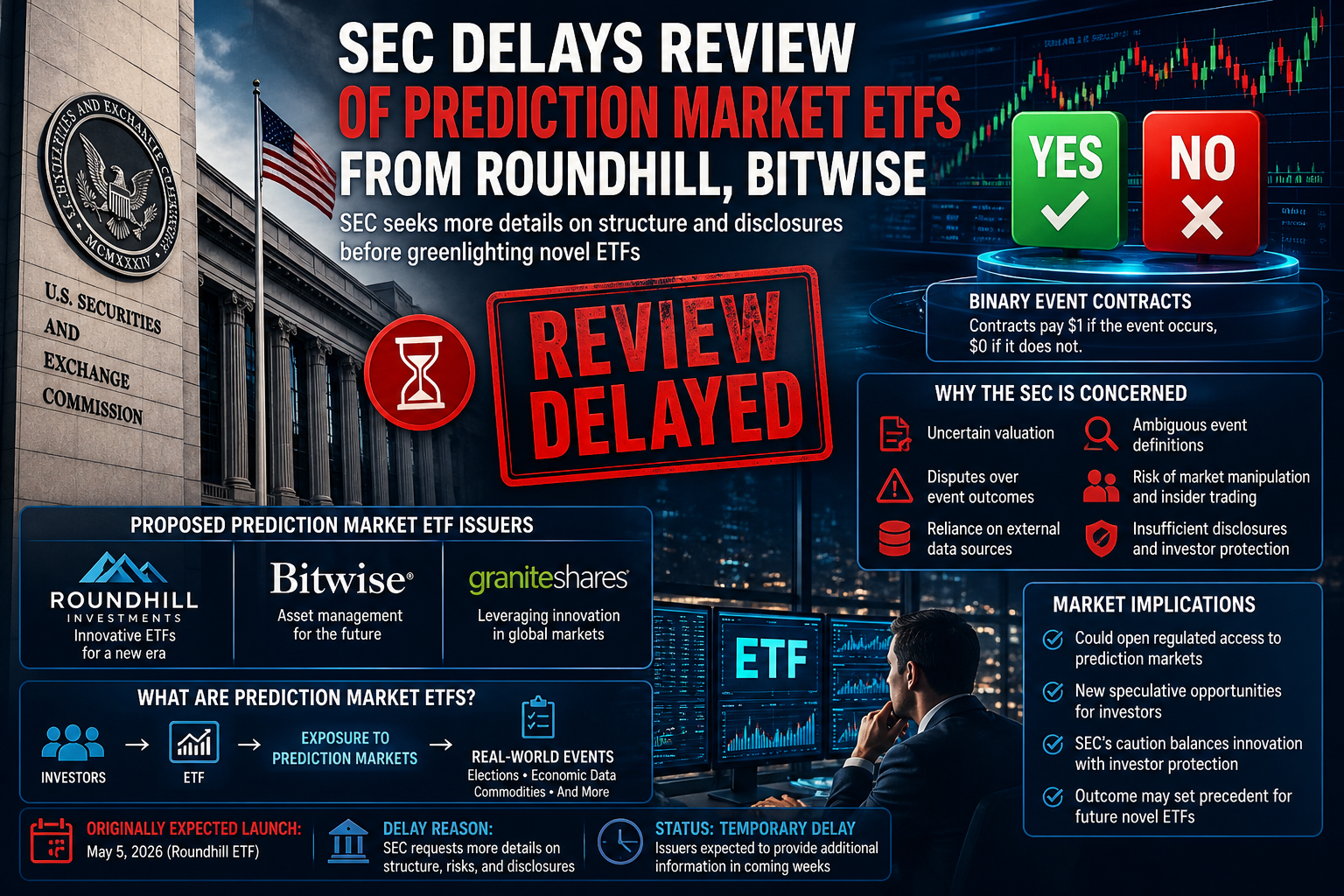
The U.S. Securities and Exchange Commission has delayed its review of more than two dozen prediction market ETFs proposed by firms including Roundhill Investments, Bitwise Asset Management, and GraniteShares. The decision, reported on May 4, 2026, comes as regulators seek additional clarity on the structure, risk disclosures, and mechanics of these novel financial products.
The proposed ETFs are designed to give investors exposure to binary event contracts—financial instruments tied to real-world outcomes such as elections, economic indicators, and commodity price movements. These products would allow traditional investors to participate in prediction markets without directly using specialized platforms. However, the delay highlights the SEC’s cautious stance on integrating such experimental instruments into mainstream finance, a trend also seen in JPMorgan’s tokenization outlook for financial markets.
Concerns Around Structure and Risk Disclosure
Prediction market ETFs represent a new frontier in financial engineering. These products rely on derivatives that settle based on binary outcomes—typically paying $1 if an event occurs and $0 if it does not. While this structure simplifies access for investors, it introduces complexities around valuation, data accuracy, and dispute resolution.
Regulators are particularly focused on how these ETFs define and verify event outcomes. Issues such as ambiguous criteria, timing discrepancies, and reliance on external data sources could create uncertainty for investors. The SEC’s request for additional disclosures suggests that issuers must provide stronger safeguards before these products can move forward.
This cautious approach reflects broader regulatory trends across crypto and financial markets, including those discussed in DeFi security concerns and trust issues, where risk management remains a key barrier to adoption.
Regulatory Scrutiny and Market Integrity Risks
Prediction markets have long faced regulatory scrutiny due to concerns around insider trading, market manipulation, and ethical considerations. Because these markets are directly tied to real-world events, there is an inherent risk that participants with privileged information could influence outcomes or trading activity.
The SEC’s delay indicates that it is prioritizing investor protection over speed to market. While innovation continues to push boundaries, regulators are aiming to ensure that new financial products meet established standards for transparency and fairness.
For broader market context and ETF trends, investors can explore ETF insights and regulatory updates directly from the SEC’s official site.
Delay Likely Temporary, Not Rejection
Despite the setback, the delay does not appear to be a rejection. Analysts suggest that the SEC’s move is procedural, giving issuers time to refine their filings and address outstanding concerns. Bloomberg ETF analyst Eric Balchunas had previously expected a launch timeline in early May, but that schedule is now uncertain.
If approved, these ETFs could represent a major expansion of financial markets, offering both retail and institutional investors new ways to speculate on real-world events. This aligns with the broader evolution of financial instruments, where traditional and digital markets are increasingly converging—similar to trends seen in Bitcoin’s growing institutional relevance.
Market Implications: Innovation Meets Regulation
The SEC’s decision underscores the complexity of introducing new asset classes into regulated markets. While prediction market ETFs offer significant potential, they also challenge traditional frameworks around valuation, compliance, and risk management.
For investors, the key takeaway is that innovation in financial products often comes with regulatory delays. As issuers work to meet compliance standards, the timeline for approval will depend on how effectively they address the SEC’s concerns.
At the same time, the outcome of this review could set a precedent for future products, particularly those blending traditional finance with emerging technologies. Real-time market data and ETF trends can be tracked via CoinMarketCap for broader crypto-linked financial activity.
Outlook: A Defining Moment for Prediction Markets
The development of prediction market ETFs represents a significant step toward mainstream adoption of event-based financial instruments. However, their success will depend on regulatory approval, market demand, and the ability to manage associated risks effectively.
As the SEC continues its review, the prediction market ETF space could become a key testing ground for how far financial innovation can go within existing regulatory frameworks. The coming months will likely determine whether these products move forward or remain on the sidelines.