







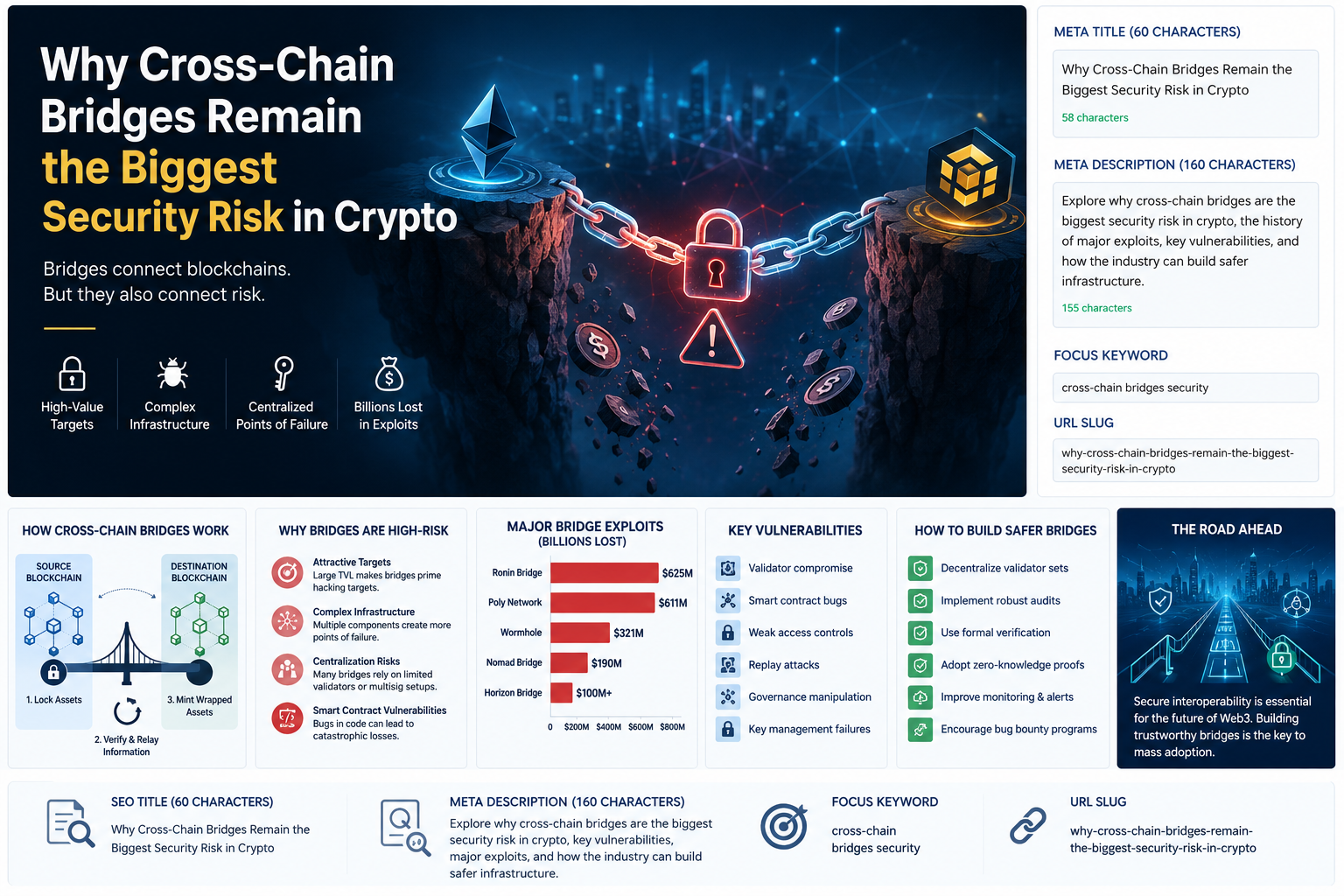
Cross-chain bridges have become one of the most important — and most vulnerable — components of blockchain infrastructure.
- What Are Cross-Chain Bridges?
- Why Cross-Chain Bridges Became Critical for DeFi
- Why Cross-Chain Bridges Are So Vulnerable
- The Biggest Bridge Exploits in Crypto History
- Why Wrapped Assets Create Additional Risk
- Why Interoperability Expands Attack Surfaces
- Why Institutional Adoption Depends on Better Bridge Security
- How AI and Advanced Auditing Are Improving Bridge Security
- Are Fully Decentralized Bridges Possible?
- Why Bridge Security Could Shape the Future of Web3
- Final Thoughts
- FAQ
As the cryptocurrency ecosystem expanded across multiple blockchain networks such as:
- Ethereum
- Solana
- Avalanche
- BNB Chain
- Polygon
- Arbitrum
users increasingly needed ways to move assets and data between otherwise isolated ecosystems.
Cross-chain bridges emerged as the solution.
These systems allow tokens, liquidity, and blockchain messages to move across different networks, helping create a more interconnected Web3 ecosystem.
However, despite their importance, bridges have also become one of the largest attack surfaces in the entire blockchain industry.
Over the past several years, bridge exploits have resulted in billions of dollars in losses across decentralized finance (DeFi), exposing critical weaknesses in:
- smart contract security
- validator systems
- custody architecture
- interoperability infrastructure
As tokenized finance and multi-chain ecosystems continue expanding, cross-chain bridge security is becoming one of the most important challenges facing the future of Web3 infrastructure.
What Are Cross-Chain Bridges?
Blockchains are typically designed as isolated networks with their own:
- consensus systems
- token standards
- security models
- validators
- transaction environments
This creates interoperability problems.
Assets on one blockchain cannot naturally move to another blockchain without additional infrastructure.
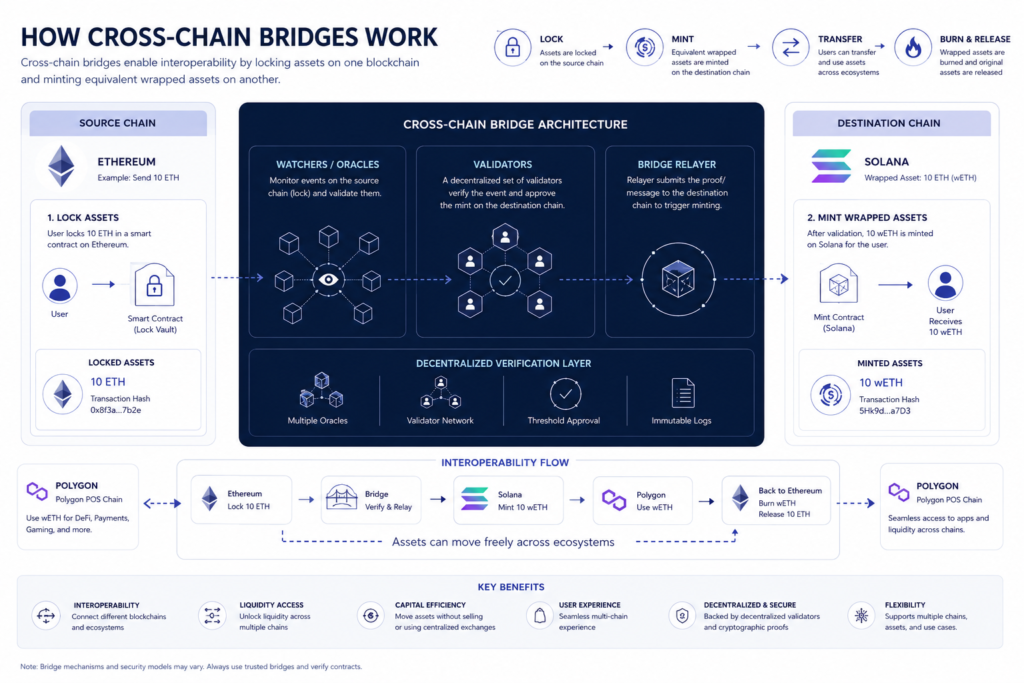
Cross-chain bridges solve this by creating systems that:
- lock assets on one chain
- issue representations on another chain
- synchronize blockchain communication
- facilitate interoperability
For example:
- ETH on Ethereum may be locked
- a wrapped version is minted on another blockchain
- users interact within the secondary ecosystem
This allows liquidity and assets to move across networks.
As blockchain ecosystems become increasingly interconnected, bridges are becoming foundational infrastructure for:
- DeFi
- NFT ecosystems
- gaming platforms
- tokenized finance
- multi-chain applications
Growing discussions around major blockchain ecosystems show how interoperability is becoming essential for scalable Web3 infrastructure:
Why Cross-Chain Bridges Became Critical for DeFi
The rapid growth of decentralized finance accelerated demand for interoperability infrastructure.
Different blockchain ecosystems offered different advantages:
- Ethereum provided liquidity and ecosystem maturity
- Solana focused on speed
- Polygon reduced transaction costs
- Avalanche supported customizable infrastructure
Users increasingly wanted access to:
- multi-chain liquidity
- yield opportunities
- decentralized exchanges
- NFT ecosystems
- tokenized assets
Bridges enabled this expansion by allowing assets to move between ecosystems.
Without interoperability infrastructure, blockchain networks would remain fragmented silos with limited liquidity coordination.
Cross-chain bridges became essential for:
- liquidity migration
- DeFi scalability
- ecosystem expansion
- capital efficiency
However, this rapid growth also introduced major security risks.
Why Cross-Chain Bridges Are So Vulnerable
Cross-chain bridges are uniquely difficult to secure because they combine:
- multiple blockchain systems
- smart contracts
- validators
- cryptographic verification
- liquidity custody
This complexity creates numerous potential attack vectors.
Unlike single-chain applications, bridges often rely on:
- external validators
- multisig systems
- wrapped assets
- message relays
- offchain coordination
Each additional component increases the risk of:
- coding vulnerabilities
- governance weaknesses
- operational failures
- validator compromise
Many bridges also custody massive amounts of liquidity.
This makes them extremely attractive targets for attackers because successful exploits can produce enormous payouts.
Bridge vulnerabilities are not isolated technical issues — they represent systemic infrastructure risks across the broader Web3 ecosystem.
The Biggest Bridge Exploits in Crypto History
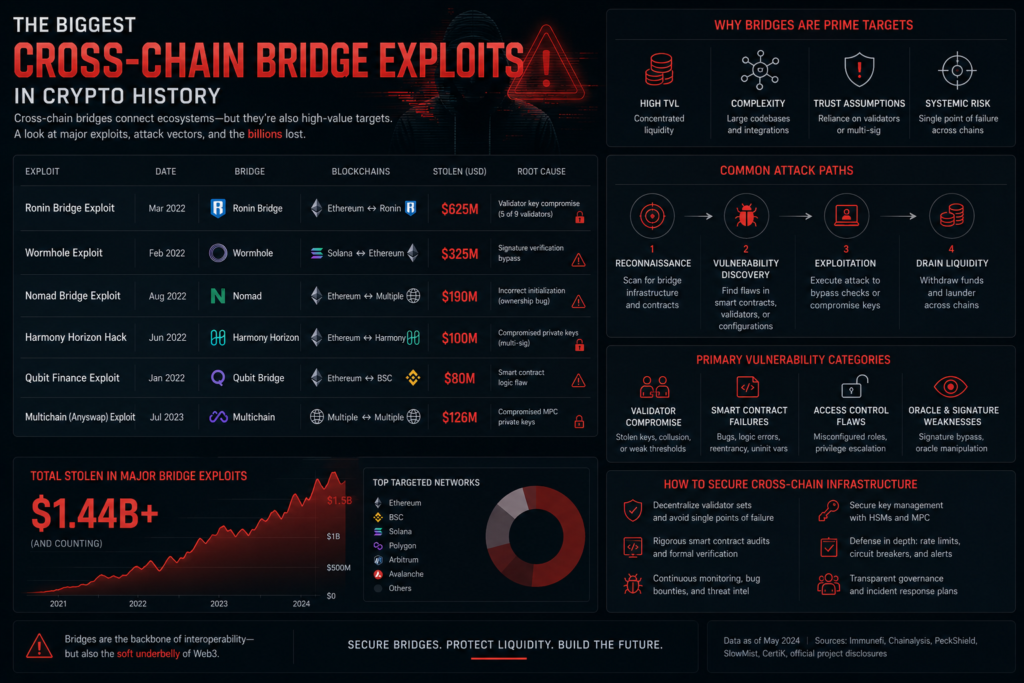
Several of the largest crypto exploits in history have involved cross-chain infrastructure.
These attacks exposed how dangerous bridge vulnerabilities can become when large liquidity pools and weak security models intersect.
Major bridge exploits have involved:
- validator compromise
- smart contract flaws
- signature verification failures
- governance manipulation
- key management weaknesses
In many cases, attackers exploited centralized points of failure hidden inside supposedly decentralized systems.
These incidents demonstrated that many bridge architectures prioritized:
- speed
- scalability
- growth
over:
- infrastructure resilience
- security decentralization
- operational safeguards
The scale of losses also significantly damaged trust across DeFi ecosystems.
Growing concerns surrounding DeFi security risks continue influencing institutional confidence in blockchain infrastructure:
Why Wrapped Assets Create Additional Risk
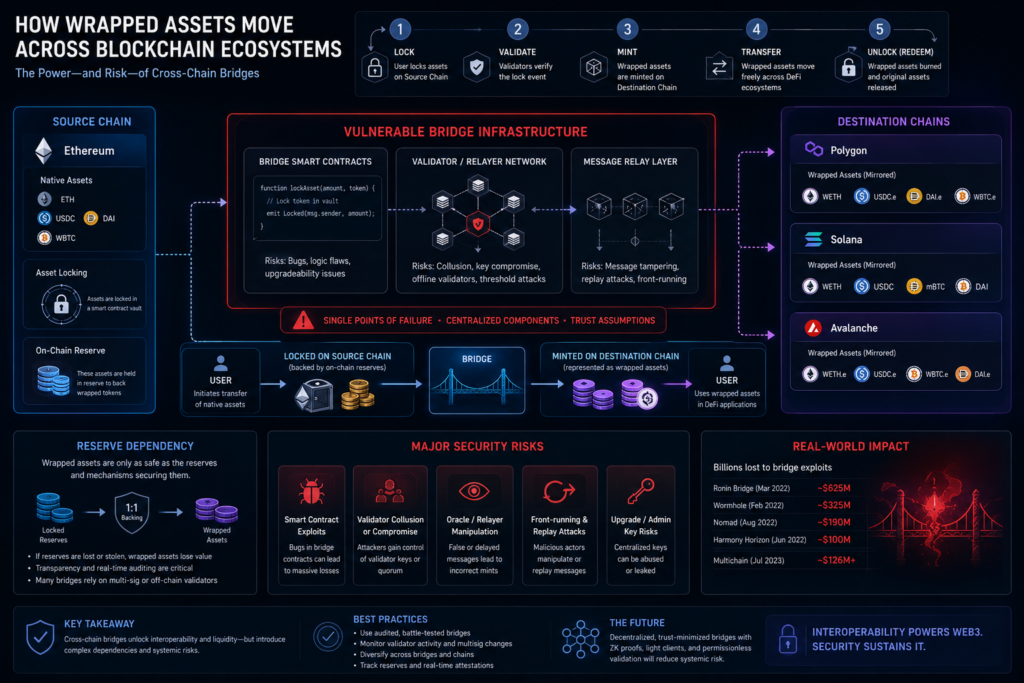
Most bridges operate using wrapped asset systems.
This means:
- original assets are locked on one blockchain
- synthetic versions are minted elsewhere
For example:
- BTC may become wrapped BTC (WBTC)
- ETH may become bridged ETH
- stablecoins may exist across multiple ecosystems
This structure introduces dependency risk.
Users must trust that:
- reserves are properly secured
- wrapped assets remain redeemable
- validators operate honestly
- bridge operators maintain integrity
If a bridge fails or is exploited, wrapped assets may lose backing or become inaccessible.
This creates systemic contagion risks because many DeFi ecosystems rely heavily on bridged liquidity.
Why Interoperability Expands Attack Surfaces

Every additional blockchain connection increases infrastructure complexity.
Bridges often interact with:
- multiple consensus models
- different virtual machines
- varying smart contract standards
- cross-chain messaging systems
This creates expanded attack surfaces compared to single-chain protocols.
Attackers frequently target:
- validator coordination
- message verification logic
- replay vulnerabilities
- governance systems
- key management infrastructure
The more ecosystems become interconnected, the greater the risk of cascading failures across multiple networks simultaneously.
This is one reason why organizations increasingly warn about tokenized financial infrastructure becoming vulnerable to systemic interoperability risks:
Why Institutional Adoption Depends on Better Bridge Security
Institutional finance is increasingly exploring blockchain infrastructure for:
- settlements
- tokenized assets
- digital securities
- treasury systems
- cross-border transfers
However, institutions require:
- infrastructure reliability
- operational resilience
- predictable security standards
- regulatory compliance
Repeated bridge exploits create major concerns for:
- banks
- asset managers
- payment providers
- regulators
Large-scale financial systems cannot depend on infrastructure that regularly suffers catastrophic security failures.
This is one reason why institutional blockchain adoption remains heavily focused on:
- permissioned infrastructure
- regulated custody
- enterprise-grade security systems
rather than fully open interoperability environments.
Growing discussions around institutional blockchain adoption show how financial institutions are increasingly prioritizing infrastructure stability.
How AI and Advanced Auditing Are Improving Bridge Security
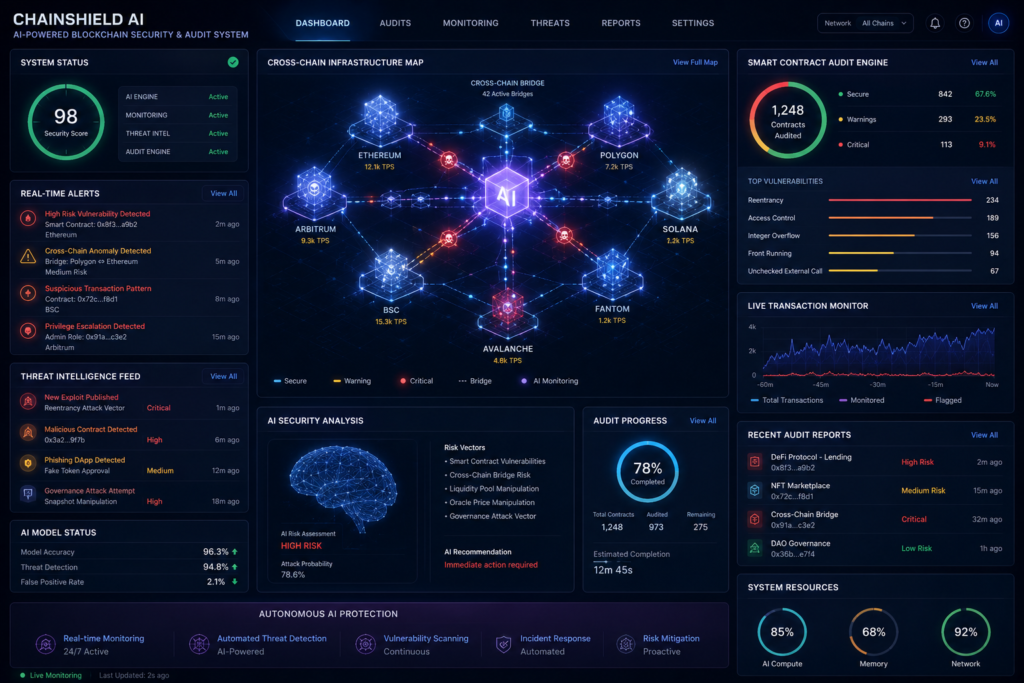
As bridge infrastructure becomes more complex, blockchain security systems are increasingly integrating:
- AI-assisted auditing
- automated vulnerability detection
- behavioral anomaly monitoring
- smart contract simulation systems
Modern smart contract security systems are evolving to identify vulnerabilities before deployment.
AI-powered infrastructure may help improve:
- attack detection
- validator monitoring
- exploit prediction
- operational resilience
However, no system can fully eliminate risk in highly interconnected blockchain environments.
Security ultimately depends on:
- architecture quality
- decentralization
- governance resilience
- operational discipline
Are Fully Decentralized Bridges Possible?
One of the biggest challenges in bridge infrastructure is balancing:
- decentralization
- scalability
- security
Many bridges marketed as decentralized still rely on:
- centralized validators
- multisig operators
- limited governance participants
Achieving truly decentralized interoperability remains extremely difficult because bridges must coordinate trust between independent blockchain systems.
Future bridge architectures may increasingly rely on:
- zero-knowledge proofs
- light client verification
- cryptographic interoperability
- decentralized consensus coordination
These technologies may improve security over time, but widespread adoption remains gradual.
Why Bridge Security Could Shape the Future of Web3

Interoperability is essential for the future of blockchain ecosystems.
Without bridges, Web3 risks remaining fragmented across isolated networks.
However, bridge vulnerabilities also represent one of the greatest systemic risks facing decentralized infrastructure.
As blockchain systems increasingly support:
- tokenized finance
- institutional settlements
- digital ownership
- stablecoin ecosystems
- global payments
cross-chain security becomes even more important.
The long-term success of Web3 may depend heavily on whether interoperability infrastructure can become:
- secure
- scalable
- decentralized
- resilient
without introducing catastrophic systemic vulnerabilities.
Final Thoughts
Cross-chain bridges remain one of the most important — and dangerous — layers within blockchain infrastructure.
They enable:
- interoperability
- liquidity movement
- multi-chain ecosystems
- scalable DeFi systems
but also introduce massive technical complexity and systemic risk.
Repeated bridge exploits have shown that interoperability infrastructure is still maturing and remains vulnerable to:
- smart contract failures
- validator compromise
- governance weaknesses
- operational mistakes
As tokenized finance and institutional blockchain adoption continue expanding, the pressure to improve bridge security will only increase.
The future of decentralized finance may ultimately depend on whether Web3 can build interoperability systems that are not only efficient — but trustworthy enough to support global-scale financial infrastructure.
FAQ
What are cross-chain bridges?
Cross-chain bridges are blockchain systems that allow assets and data to move between different blockchain networks.
Why are cross-chain bridges risky?
Bridges involve complex infrastructure, large liquidity pools, and multiple trust assumptions that create significant attack surfaces.
What are wrapped assets?
Wrapped assets are blockchain-based representations of assets locked on another blockchain network.
Why do DeFi platforms rely on bridges?
Bridges enable liquidity movement, interoperability, and access to multi-chain decentralized applications and financial systems.
Can bridge security improve in the future?
Advanced auditing, AI-assisted monitoring, cryptographic verification systems, and decentralized bridge architectures may improve security over time.