


WEB3 UPDATES — YOUR #1 SOURCE FOR BLOCKCHAIN & CRYPTO NEWS

  • MARKETCAP
Web3 Updates logo Web3 updates logo in dark
  • Crypto Guides & Analysis
  • Web3 & Infrastructure
  • Blockchain Infrastructure
  • Web3 Security & Auditing
  • About us
  • Contact us
Reading: Cross-Chain Bridge Security Risks: Attack Vectors, Architectural Flaws, and Mitigation Frameworks
Share
  • bitcoinBitcoin(BTC)$76,776.00
  • ethereumEthereum(ETH)$2,477.74
  • tetherTether(USDT)$1.00
  • binancecoinBNB(BNB)$716.85
  • rippleXRP(XRP)$1.34
  • usd-coinUSDC(USDC)$1.00
  • solanaSolana(SOL)$99.94
  • tronTRON(TRX)$0.340660
  • Figure HelocFigure Heloc(FIGR_HELOC)$1.00
  • zcashZcash(ZEC)$1,090.70
Font ResizerAa
  • Home
  • Contact
Search
  • Demos
    • Home 1
  • Categories
    • Coinbase
    • Mining
    • Stocks
  • Bookmarks
    • Customize Interests
  • More Foxiz
    • Blog Index
    • Sitemap
Have an existing account? Sign In
Follow US
© Foxiz News Network. Ruby Design Company. All Rights Reserved.
Web3 Security & Auditing

Cross-Chain Bridge Security Risks: Attack Vectors, Architectural Flaws, and Mitigation Frameworks

Fatima Tahir Web3 Updates
Last updated: September 2, 2026 2:28 pm
Fatima
Fatima Tahir Web3 Updates
ByFatima
Senior Editor
Fatima Tahir is a Web3 editor and blockchain industry researcher focused on blockchain infrastructure, decentralized finance (DeFi), Web3 security, tokenized finance, cryptocurrency ecosystems, and institutional blockchain...
Follow:
- Senior Editor
Published: May 18, 2026
Share
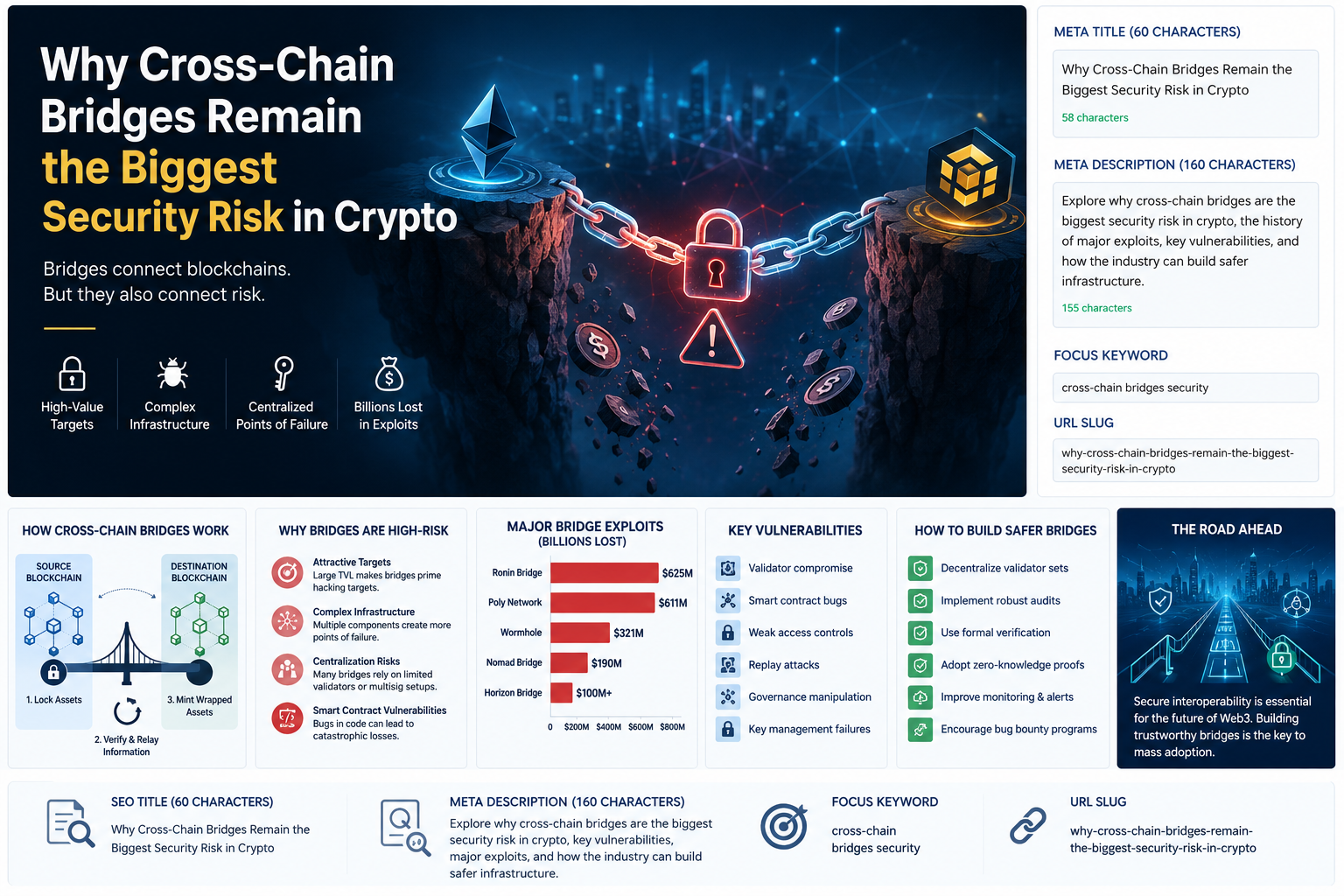
Cross-chain blockchain bridge vulnerabilities and Web3 security infrastructure risks

As decentralized finance has evolved from isolated blockchain ecosystems into a multi-network web across the largest cryptocurrency ecosystems, the demand for moving liquidity across disparate execution environments has grown exponentially. Cross-chain bridges have emerged as indispensable infrastructure, allowing users to trade on low-cost networks, chase lending yields on multi-chain money markets, and transfer liquidity between Layer 1s and Layer 2s.

Contents
  • How Cross-Chain Bridges Actually Work: Architectural Mechanics
    • The Illusion of “Transferring” Crypto
  • Trusted vs. Trustless Bridge Architecture
  • Vitalik Buterin’s Cross-Chain Security Thesis: The 51% Attack Contagion
    • The Inherent Vulnerability of Wrapped Assets
  • Anatomy of Major Bridge Exploits: What Went Wrong?
    • 1. The Wormhole Bridge Hack ($326M) — Signature Verification Bypass
    • 2. The Ronin Bridge Hack ($624M) — Validator Multi-Sig Compromise
    • 3. The Poly Network Hack ($611M) — Arbitrary Execution & Privilege Escalation
    • 4. The Qubit Finance Hack ($80M) — Logic & Deprecation Oversights
  • Technical Comparison: Vulnerable vs. Secure Cross-Chain Handlers
    • Vulnerable Code: Unconstrained Cross-Chain Execution
    • Secure Code: Cryptographic Nonces, Domain Separation, and Signer Checks
  • Comprehensive Defense-in-Depth Framework for Bridges
    • 1. Zero-Knowledge Light Clients (zk-Bridges)
    • 2. Dual-Network Risk Monitoring (Watchtowers)
    • 3. Programmatic Circuit Breakers & Dynamic Rate-Limiting
    • 4. Mitigating Governance Attack Vectors
  • 7. Strategic Multi-Chain Integration & Risk Hygiene
  • Frequently Asked Questions (FAQ)
    • Why are cross-chain bridges more vulnerable than individual dApps?
    • What is the difference between a wrapped asset and a natively bridged asset?
    • How does a 51% attack on one blockchain affect connected bridges?
    • What is a bridge circuit breaker?
    • Sources & Further Reference

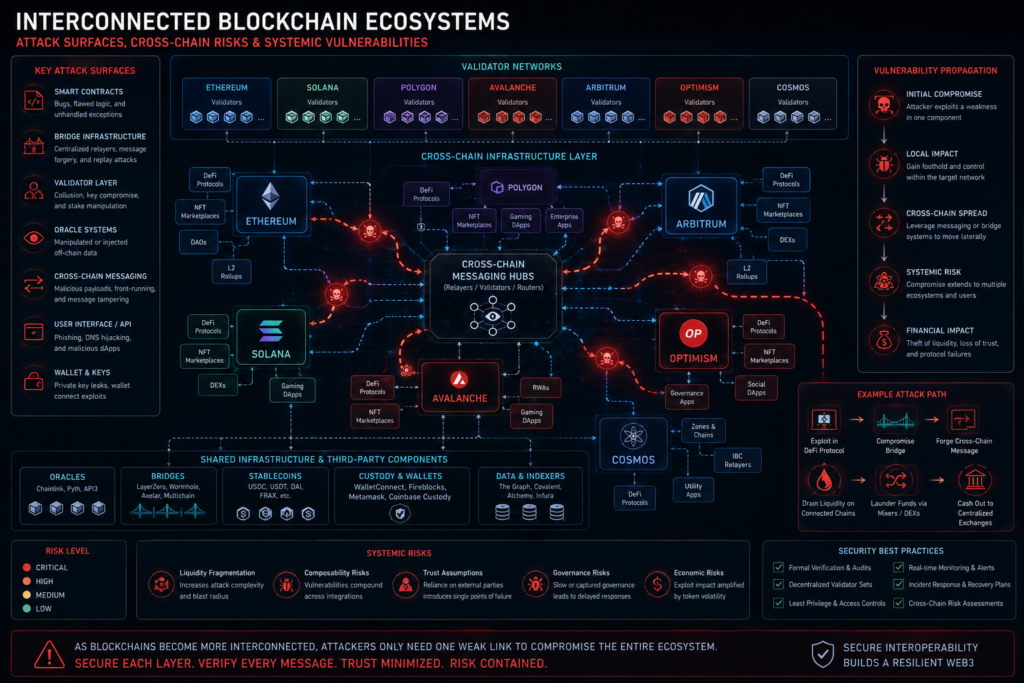
However, this unprecedented connectivity comes with systemic vulnerability. Cross-chain bridges represent the single largest point of catastrophic failure in Web3, accounting for over $2.8 billion in stolen capital across decentralized finance. Unlike a bug in an isolated automated market maker (AMM) or lending protocol—where financial contagion is bounded by the assets deposited in that single contract—a vulnerability in a cross-chain bridge can undermine the collateral backing entire ecosystems of wrapped tokens, triggering cascading liquidations across multiple chains simultaneously.

This technical guide breaks down the core architecture of blockchain bridges, examines why cross-chain connectivity introduces asymmetric security risks, explores the attack vectors behind major exploits (including Wormhole, Ronin, Poly Network, and Qubit), and outlines the engineering frameworks needed to build resilient multi-chain infrastructure.

How Cross-Chain Bridges Actually Work: Architectural Mechanics

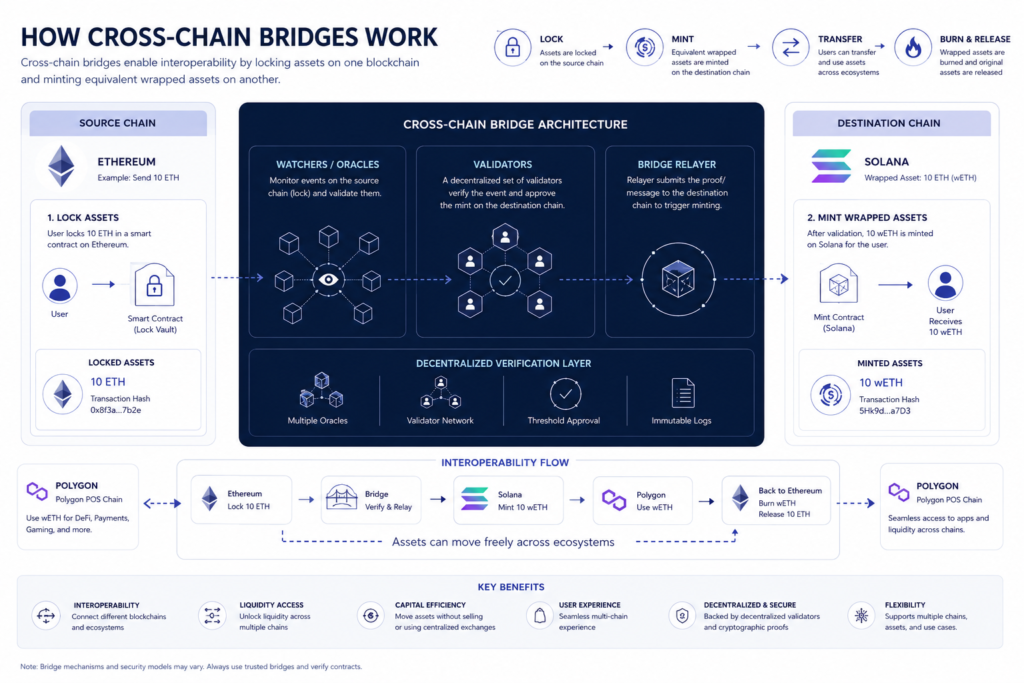
A fundamental design property of any Layer 1 blockchain is that it is self-contained. Blockchains cannot natively query external APIs, read state variables on foreign networks, or verify remote consensus without an external intermediary mechanism. A smart contract on Ethereum cannot independently confirm whether a transaction successfully reached finality on Solana, Avalanche, or Polygon.

+-------------------------------------------------------------------------------+
|                       STANDARD CROSS-CHAIN BRIDGE MECHANICS                   |
|                                                                               |
|  SOURCE CHAIN (e.g., Ethereum)                DESTINATION CHAIN (e.g., Solana)|
|  [ User Deposits 10 ETH ]                     [ User Receives 10 wETH ]       |
|           |                                                  ^                |
|           v                                                  |                |
|  [ Bridge Escrow Contract ]                                  | (Mint Event)   |
|     (Funds Locked)                                           |                |
|           |                                                  |                |
|           v                                                  |                |
|  [ Deposit Event Emitted ] ---> [ Relayers / Oracles ] ---> [ Proof Verified] |
|                                 (Validators Confirm)        [ Contract Mints] |
+-------------------------------------------------------------------------------+

The Illusion of “Transferring” Crypto

When users bridge tokens from one chain to another, assets are not physically moved across chains. The native tokens remain permanently hosted on their home network:

  1. Locking Phase: The user sends native tokens (e.g., Ether) to a centralized bridge vault or decentralized smart contract on the source chain. The contract locks the assets, removing them from circulating supply.
  2. Attestation & Messaging: An off-chain communication layer—consisting of oracles, relayer nodes, or multi-signature validators—monitors the source smart contract. Once they detect the deposit transaction, they sign cryptographic attestations confirming that the funds are locked.
  3. Minting Phase: The message is relayed to a factory smart contract on the destination chain. Upon verifying the cryptographic signatures, the destination contract mints a synthetic or “wrapped” representation (e.g., wrapped Ether or wETH) and credits the recipient’s wallet.
  4. Redemption & Burning: To reverse the process, the user submits the wrapped token on the destination chain to be burned. The bridge relayer verifies the burn event, and the escrow contract on the source chain releases the underlying native tokens back to the user.

Trusted vs. Trustless Bridge Architecture

Cross-chain bridges generally fall into two broad security categories: trusted (centralized) and trustless (decentralized) models.

Feature / DimensionTrusted (Trust-Based) BridgesTrustless (Algorithmic / Light-Client) BridgesNative Burn-and-Mint Protocols (e.g., CCTP)
Validation MechanismCentralized custodian, federation, or off-chain multi-sigSmart contract consensus, on-chain light clients, or ZK-SNARKsCanonical issuer mint/burn via verified smart contracts
Collateral StructureEscrowed custodial vault or multi-sig walletSmart contract liquidity pool or lock-and-mint escrowDirect programmatic burn and issuance (no wrapped debt)
Capital EfficiencyHigh (fast transaction processing, lower gas)Moderate (requires validator incentives & proof verification)High (zero wrapped liquidity fragmentation)
Primary Failure ModesPrivate key theft, insider collusion, regulatory seizureLogic exploits, faulty signature verification, proof forgingIssuer centralization, master admin key compromise
Prominent ExamplesWBTC (custodial BitGo), early Ronin (5/9 multi-sig)Wormhole, Poly Network, Nomad, LayerZeroCircle CCTP (powering modern stablecoin payment infrastructure)

Vitalik Buterin’s Cross-Chain Security Thesis: The 51% Attack Contagion

One of the most critical structural arguments against cross-chain bridges was highlighted by Ethereum co-founder Vitalik Buterin. Buterin argued that while the future of Web3 is inherently multi-chain (multiple sovereign chains serving independent ecosystems), it is fundamentally constrained from becoming completely cross-chain due to asymmetric security dependencies.

+--------------------------------------------------------------------------+
|                  THE CROSS-CHAIN SECURITY ASYMMETRY                      |
|                                                                          |
|  SCENARIO A: Ethereum Native                                             |
|  [ ETH on Ethereum ]  ---> 51% Attack on Ethereum?                       |
|                            Result: Honest chain recovers via hard fork.  |
|                            Status: HIGH SECURITY                         |
|                                                                          |
|  SCENARIO B: Bridged Synthetic Asset                                     |
|  [ 100 ETH locked on Ethereum ] ---> [ 100 wETH minted on Alternative L1]|
|                                                                          |
|  Attack: Attacker executes 51% attack on Alternative L1.                 |
|          Attacker reverts their transaction on the Alt-L1 while          |
|          withdrawing the real locked ETH on Ethereum.                    |
|  Result: Bridge contract drained. Alt-L1 wETH completely depegs to $0.   |
|  Status: SYSTEMIC FAILURE & CONTAGION                                    |
+--------------------------------------------------------------------------+

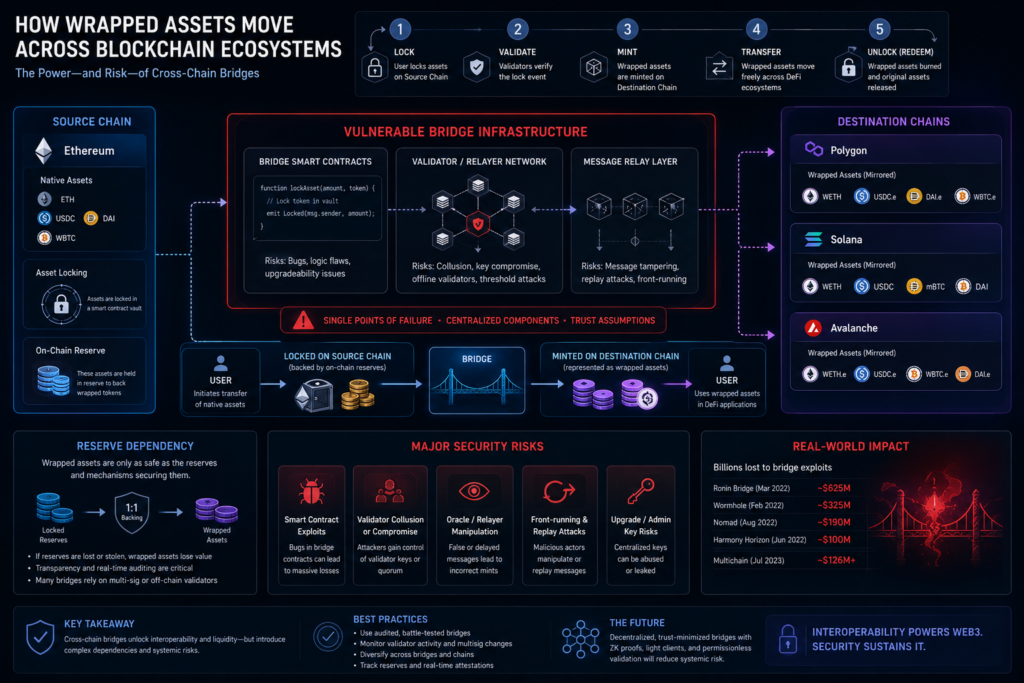
The Inherent Vulnerability of Wrapped Assets

If you hold native ETH on Ethereum and the network suffers a 51% attack, honest node operators coordinate an off-chain social consensus or soft fork, preserving ledger integrity. Your native assets remain intact.

However, if you bridge 100 ETH to an alternative, lower-security blockchain (e.g., an early-stage Layer 1 with a small validator set) to trade on decentralized money markets, your 100 wrapped ETH is backed by collateral sitting inside an Ethereum bridge vault. If malicious actors execute a 51% reorganization on the alternative Layer 1, they can double-spend, forge synthetic balances, or withdraw the underlying native ETH on Ethereum.

The wrapped tokens remaining on the destination chain immediately lose their backing and collapse to zero, regardless of whether you stored them in a secure hardware wallet. Your asset security is no longer determined by the most secure network (Ethereum); it is bound to the weakest link in the cross-chain bridge path.

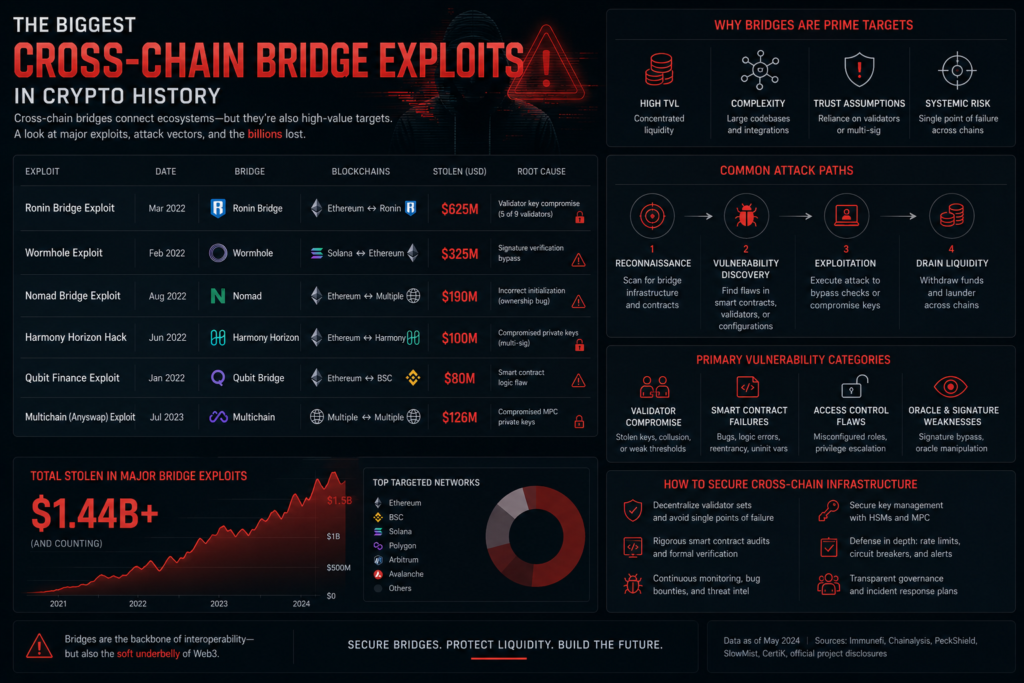
Anatomy of Major Bridge Exploits: What Went Wrong?

Examining historical exploits illustrates that bridge failures stem from distinct failure modes across software verification, key management, and accounting logic.

+--------------------------------------------------------------------------+
|                     FOUR NOTABLE CROSS-CHAIN HACKS                       |
|                                                                          |
|  [ Wormhole: $326M ]     -> Signature verification bypass (Solana VM)    |
|  [ Ronin: $624M ]        -> Compromise of 5-of-9 validator private keys  |
|  [ Poly Network: $611M ] -> Unchecked arbitrary external contract calls  |
|  [ Qubit / QBridge: $80M]-> Deprecated deposit function address spoofing |
+--------------------------------------------------------------------------+

1. The Wormhole Bridge Hack ($326M) — Signature Verification Bypass

In February 2022, a hacker exploited the Wormhole bridge connecting Ethereum and Solana, draining over 120,000 wETH ($326 million at the time).

  • The Flaw: Wormhole relied on an off-chain set of 19 “Guardian” validators to sign cross-chain transfers via a core contract function. On the Solana side, the contract checked Guardian signatures using a system instruction program (verify_signatures).
  • The Exploit: The attacker substituted the legitimate Solana system sysvar instruction contract with a spoofed account containing identical memory layouts. The bridge contract accepted the fake account, bypassed the cryptographic signature verification loop entirely, and minted 120,000 wETH without depositing a single Wei into the Ethereum vault.
  • Resolution: The exploit was neutralized only because venture capital firm Jump Crypto backstopped the $320M shortfall to restore the 1:1 backing of wrapped ETH.

2. The Ronin Bridge Hack ($624M) — Validator Multi-Sig Compromise

In March 2022, the Ronin Network (an Ethereum sidechain built by Sky Mavis for the game Axie Infinity) suffered the largest single hack in Web3 history, losing over $614 million in ETH and USDC.

  • The Flaw: Ronin utilized a federated Proof-of-Authority (PoA) model consisting of only nine validator nodes. Approving a deposit or withdrawal required a 5-out-of-9 signature quorum.
  • The Exploit: The North Korean-backed Lazarus Group conducted targeted spear-phishing campaigns against Sky Mavis engineers, compromising four private keys. To secure the fifth required key, the attackers leveraged an existing third-party access RPC whitelist from the Axie DAO validator that had not been revoked following an earlier traffic spike, giving the attackers control over 5 of the 9 nodes.
  • The Takeaway: Decentralized smart contracts offer zero protection if off-chain key management fails.

3. The Poly Network Hack ($611M) — Arbitrary Execution & Privilege Escalation

In August 2021, Poly Network was drained of $611 million across Ethereum, Binance Smart Chain, and Polygon.

  • The Flaw: Poly Network used an EthCrossChainManager contract designed to execute generalized cross-chain contract calls.
  • The Exploit: The contract allowed callers to supply arbitrary target contract addresses and custom byte payloads without enforcing an internal whitelist. The attacker crafted a specific cryptographic method hash that triggered the management contract to invoke putCurEpochConPubKeyBytes—a privileged function inside the bridge’s consensus data keeper contract. This unauthorized call overwrote the public keys of the authentic validators, replacing them with the hacker’s own address.

4. The Qubit Finance Hack ($80M) — Logic & Deprecation Oversights

In early 2022, Qubit Finance’s cross-chain bridge (QBridge) was exploited for $80 million on BNB Smart Chain. Despite having undergone multiple smart contract audits, a logic flaw remained:

  • The Flaw: When users deposited native ETH on Ethereum, the contract emitted a deposit event. For ERC-20 tokens, it called a separate deposit function. During a recent update, the team deprecated native ETH handling but left the original code exposed.
  • The Exploit: The attacker called the deposit function with token address 0x0000000000000000000000000000000000000000 (representing native ETH) while passing a zero transfer. The contract failed to revert, misinterpreted the call, emitted an authentic deposit event for 7,797 ETH, and credited the hacker’s address on Binance Smart Chain without any capital locked on Ethereum.

Technical Comparison: Vulnerable vs. Secure Cross-Chain Handlers

To safeguard cross-chain contracts against replay attacks, arbitrary execution, and signature forgery, developers must implement strict cryptographic domain separation and unique nonce tracking.

Vulnerable Code: Unconstrained Cross-Chain Execution

Solidity

// SPDX-License-Identifier: MIT
pragma solidity ^0.8.20;

contract UnsafeBridgeReceiver {
    address public bridgeAdmin;

    // VULNERABILITY: Arbitrary target and calldata allows attackers
    // to hijack this contract's privileged authority.
    function executeRemoteTransaction(
        address targetContract, 
        bytes calldata payload
    ) external {
        (bool success, ) = targetContract.call(payload);
        require(success, "Execution failed");
    }
}

Secure Code: Cryptographic Nonces, Domain Separation, and Signer Checks

Solidity

// SPDX-License-Identifier: MIT
pragma solidity ^0.8.20;

import "@openzeppelin/contracts/utils/cryptography/ECDSA.sol";
import "@openzeppelin/contracts/utils/cryptography/MessageHashUtils.sol";
import "@openzeppelin/contracts/access/Ownable.sol";

contract SecureBridgeReceiver is Ownable {
    using ECDSA for bytes32;

    uint256 public immutable currentChainId;
    address public trustedRelayer;

    // Track executed message hashes to eliminate replay attacks
    mapping(bytes32 => bool) public processedTransactions;

    event TokensMinted(address indexed recipient, uint256 amount, uint256 nonce);

    constructor(uint256 _chainId, address _relayer) Ownable(msg.sender) {
        currentChainId = _chainId;
        trustedRelayer = _relayer;
    }

    function processBridgedDeposit(
        address recipient,
        uint256 amount,
        uint256 nonce,
        uint256 sourceChainId,
        bytes calldata signature
    ) external {
        // 1. Strict Domain Separation: Bind payload to specific source & destination chains
        bytes32 messageHash = keccak256(
            abi.encodePacked(recipient, amount, nonce, sourceChainId, currentChainId)
        );
        bytes32 ethSignedMessageHash = MessageHashUtils.toEthSignedMessageHash(messageHash);

        // 2. Prevent Replay Attacks: Ensure payload has never been processed
        require(!processedTransactions[messageHash], "Replay attack detected: already processed");

        // 3. Cryptographic Signature Verification
        address recoveredSigner = ethSignedMessageHash.recover(signature);
        require(recoveredSigner == trustedRelayer, "Unauthorized relayer signature");

        // 4. Update state BEFORE external transfers (Reentrancy protection)
        processedTransactions[messageHash] = true;

        // Execute release
        (bool success, ) = recipient.call{value: amount}("");
        require(success, "Token transfer failed");

        emit TokensMinted(recipient, amount, nonce);
    }
}

Deploying complex cross-chain contracts requires continuous automated verification through tools such as AI smart contract auditing for Web3 security combined with professional manual security reviews.

Comprehensive Defense-in-Depth Framework for Bridges

Eliminating cross-chain risk requires a layered defense model that spans cryptography, off-chain infrastructure, and economic rate limits.

+--------------------------------------------------------------------------+
|                  MULTI-TIER BRIDGE SECURITY ARCHITECTURE                 |
|                                                                          |
|  [ Layer 1: Cryptographic Proofs ] -> ZK-SNARKs & Light-Client State     |
|  [ Layer 2: Key Security / MPC   ] -> Multi-Party Compute & HSM Enclaves |
|  [ Layer 3: Risk Watchtowers     ] -> Dual-Network Independent Monitoring|
|  [ Layer 4: Economic Rate Limits ] -> Velocity Caps & Circuit Breakers   |
|  [ Layer 5: Time-Delay Escrows   ] -> 24-Hour Settlement Buffers on Whale|
+--------------------------------------------------------------------------+

1. Zero-Knowledge Light Clients (zk-Bridges)

Rather than relying on trusted third-party validator nodes, next-generation bridges utilize zero-knowledge proofs (zk-SNARKs). A smart contract on the destination chain directly verifies a mathematical cryptographic proof of the source chain’s state transitions, eliminating trust in off-chain multi-sig quorums.

2. Dual-Network Risk Monitoring (Watchtowers)

Advanced messaging layers (such as Chainlink CCIP) deploy independent secondary networks:

  • The Primary Execution Network: Routes messages and signs transfers.
  • The Risk Management Network: A separate node network built with independent software clients that monitors destination executions against source chain records. If anomalous behavior is detected, it triggers a global circuit breaker, freezing all bridging lanes.

3. Programmatic Circuit Breakers & Dynamic Rate-Limiting

Bridges must never permit unconstrained capital outflows within short time windows:

  • Token Velocity Caps: Limit hourly and daily withdrawal limits per token.
  • Time-Delays on High-Value Escrows: Require transactions exceeding a set threshold (e.g., $250,000) to undergo a mandatory 6-to-24-hour time lock, providing emergency response windows to pause contracts if a drain occurs.

4. Mitigating Governance Attack Vectors

Because bridge parameters, signers, and upgrade logic are often governed by token voting, DAOs must actively mitigate Web3 governance risks to prevent malicious flash-loan takeovers from hijacking bridge contracts.

7. Strategic Multi-Chain Integration & Risk Hygiene

As cross-chain architectures mature, bridge security forms the backbone of decentralized finance:

  • DeFi Security & Collateral Integrity: Decentralized money markets and yield protocols must evaluate broader DeFi security risks before accepting wrapped or bridged assets as collateral.
  • Tokenized Real-World Assets: Enterprise credit rails and tokenized US Treasuries built on tokenized financial infrastructure depend on secure, auditable communication to verify physical collateral backing.
  • Institutional Lending & Mortgages: Financial models like Bitcoin-backed mortgages require tamper-proof verification when custodial collateral lives on an alternate blockchain.
  • Multi-Chain Digital Assets: Cross-chain metadata routing for NFT infrastructure beyond digital art and fractional secondary markets like tokenized trading cards in DeFi rely on immutable bridge synchronization.
  • Institutional Liquidity Rails: Comparing decentralized bridge vectors with established cross-border settlement channels, like Ripple’s enterprise liquidity examined in our XRP global adoption and value impact guide, illustrates the trade-offs between public and private rails.
  • Balancing Your Web3 Allocation: Even for long-term investors tracking assets in our top 10 cryptocurrencies to invest in guide or analyzing macro projections in our Ethereum price prediction, asset custody should prioritize native chains over wrapped derivatives.
  • Transparent Communication: Protocol teams rely on top Web3 PR agencies to communicate security postures, audit disclosures, and bug bounty programs transparently to the broader community.

Frequently Asked Questions (FAQ)

Why are cross-chain bridges more vulnerable than individual dApps?

Bridges coordinate state across fundamentally incompatible blockchain environments with different consensus rules, virtual machines, and finality mechanisms. Furthermore, bridges lock massive amounts of capital into centralized escrow pools, making them lucrative targets for sophisticated attackers.

What is the difference between a wrapped asset and a natively bridged asset?

A wrapped asset is a synthetic token minted against collateral locked in a bridge smart contract on another network. If the vault is hacked, the wrapped asset loses its backing and depegs to zero. Natively bridged assets (such as USDC via Circle’s CCTP) are burned on the source chain and natively reminted on the destination network without third-party wrapped debt.

How does a 51% attack on one blockchain affect connected bridges?

If an attacker executes a 51% reorganization on a connected network, they can reverse their initial deposit on the source chain while keeping the minted wrapped assets on the destination chain. This drains the bridge vault and leaves wrapped-token holders on the destination network holding unbacked tokens.

What is a bridge circuit breaker?

A bridge circuit breaker is an automated safeguard that rate-limits withdrawal volume or freezes contract execution when anomalous transfer sizes, rapid liquidity depletion, or oracle verification failures are detected.

Sources & Further Reference

  1. DeFi Talks: The HIDDEN risk of using bridges: 300M$ stolen. Wormhole, Vitalik, and the risk of cross-chain (Analysis of the Wormhole exploit, Qubit Finance hack, and Vitalik Buterin’s cross-chain security thesis).
  2. NextGen Vision: Blockchain 101: How Cross-Chain Bridges Work? (Technical walkthrough of lock-and-mint smart contract workflows, validator monitoring, and synthetic token issuance).
  3. CoinGecko: What Is A Crypto Bridge? | Blockchain Bridge EXPLAINED For Beginners (Breakdown of trusted vs. trustless bridges, Ronin Network exploit, and Poly Network vulnerability).
  4. Vitalik Buterin Research: Why the Future is Multi-Chain, but Not Cross-Chain (Fundamental analysis of 51% attack propagation and cross-chain economic dependencies).
  5. Chainlink Architecture: Cross-Chain Interoperability Protocol (CCIP) Security & Independent Risk Management Networks.
Fatima Tahir Web3 Updates
ByFatima
Senior Editor
Follow:
Fatima Tahir is a Web3 editor and blockchain industry researcher focused on blockchain infrastructure, decentralized finance (DeFi), Web3 security, tokenized finance, cryptocurrency ecosystems, and institutional blockchain adoption. At Web3 Updates, she specializes in long-form educational analysis covering: tokenized financial systems blockchain infrastructure Web3 cybersecurity DeFi architecture NFT infrastructure AI-powered blockchain systems institutional blockchain adoption Her editorial work focuses on explaining how blockchain technology is evolving beyond speculative markets into real-world financial infrastructure, digital ownership systems, and next-generation internet applications. She contributes research-driven content designed to help readers better understand the rapidly evolving digital asset ecosystem through contextual analysis, infrastructure-focused reporting, and educational Web3 insights.
Previous Article NFT Limited CFO Resigns — Why This Finance Shakeup Matters for Investors in Public Web3 Firms NFT Limited CFO Resigns — Why This Finance Shakeup Matters for Investors in Public Web3 Firms
Next Article Stablecoin payment infrastructure and blockchain-based global financial systems The Future of Stablecoin Payment Infrastructure: Settlement Finality, Layer 2 Rails, and Institutional Paymasters

Follow Us on Socials

We use social media to react to breaking news, update supporters and share information

Twitter Telegram Linkedin
Web3 Updates logo

Web3 Updates is the number one source for blockchain, crypto, and Web3 news — trusted by millions of readers worldwide. We cover markets, DeFi, NFTs, and the latest developments shaping the decentralized future.

Contact: @web3updates_official
  • Web3
  • DeFi
  • NFT
  • Altcoin
  • Crypto
  • Ethereum
  • Mining
  • Bitcoin
  • Blockchain
  • Partners
  • About Us
  • Research Methodology
  • Privacy Policy
  • Editorial Policy
  • Terms & Conditions
  • Contact Us
Copyright © 2026 by Web3 Updates. All rights reserved.
Welcome Back!

Sign in to your account

Username or Email Address
Password

Lost your password?